Monday, September 19, 2016

River of No Return Wilderness

We enjoyed camping at the Hayspur Hatchery Campground near Silver Creek for several days, not least because it's free! We had one rainy day when we hunkered down and worked on our book projects. When the weather cleared up, we walked a nearby nature trail along Loving Creek and watched a trout slurp flies off the water's surface as they floated overhead. On our last day in the Picabo/Silver Creek Preserve area, we drove back up to the Silver Creek Preserve Visitor Center and walked their nature trail for several hours, hoping to see some moose. We know they're there because others have commented on seeing moose in the visitor's book, but we didn't see any, unfortunately. We did see lots of birds, and lots of trout, and took some final photos as we said farewell to this special area.

Goodbye photo of a stream we loved (Silver Creek). The pool in the left foreground was loaded with trout. You can see them in the photo.

Our next destination is the Frank Church River of No Return Wilderness Area. The "River of No Return" is the Middle Fork of the Salmon River, so-called because of its wild rapids and heavy current through a deep rocky canyon. This river is on Jack's list of the Top 100 trout streams but it's problematic and we've been puzzling to figure out the best way for him to check this one off. Because of the nature of this river and the fact that it's in an extreme wilderness area with very few roads, it's pretty much inaccessible. People can run it in rafts with an outfitter and fish it that way, but you have to have a state permit that is only obtained far ahead of time in a lottery, and the trip takes a minimum of 5 days! We had already determined that we weren't going to take that trip, because of the expense and not wanting to be that far from health care if needed for that many days (plus the sheer exertion of rafting and fishing all day, every day for 5 days and sleeping in a tent on the ground)

Entering the River of No Return Wilderness.
.
Jack was hoping to be able to get into the upper reaches of the river -- at least be able to fish one of the major tributaries if not the main Middle Fork itself. We had talked to a couple of fishing guides about driving our RoadTrek on the long (20-mile plus) dirt road into the launching area where the rafts put in and had gotten varying answers. Other than questions about the condition of the road itself, a separate issue was the giant Pioneer Fire (it's burned about 400 square miles so far) that's been going on near this area since mid-July. Lots of roads have been closed and in fact we'd been told by one person, who should know, that the road into the area was closed and that they were having to fly the rafters in. So Jack was now looking at fishing one of the two major tributaries, Marsh Creek or Bear Valley Creek, which we had been told were more easily accessible and had fish.

We headed off once again to drive north of Ketchum over the Galena Pass and into Stanley (where we had some yummy pizza for lunch). This time, the mountain peaks we saw from the summit of the Pass had snow on them, a reminder that winter is not far off in this neck of the woods! Lots of fall color too--very pretty drive. We were heading for Lola Creek Campground: Marsh Creek flows right by it and it's accessible from a reasonably well-maintained dirt road. As we headed off the pavement, we were approached by a woman representing the Forestry, asking us where we were heading. Because of the ongoing Pioneer Fire, they are monitoring traffic into the area and warning people off from the active parts. She gave us a map showing the current "fire footprint" and road closures. Fortunately, where we were going wasn't near the active fire.

Jack in his baggy fishing pants with snow-covered peaks in background.

The road in was washboarded but wasn't too bad. We found the campground and picked out our campsite -- very pretty, wooded, with the beautiful creek, which looked more like a river, flowing right by it. And there was just one other couple camping here! We walked down to the creek, and then Carol went up to talk with the other campers, a very nice couple from Boise, Scott and Vickie. As it turned out, they camp here often and Scott is a veteran fly fisherman. He had lots of good advice for Jack on good holes to fish. However, he told us that at this time of year, a lot of the trout in this creek have moved downstream toward the Middle Fork, where the water is deeper.

Marsh Creek looking upstream.

Marsh Creek looking downstream. 
Note fish trap where rangers tag salmon smolts for identification when they return 2 years later. 

It was early afternoon and a beautiful day, so Jack got suited up and headed for the water to try his luck.

Following is Jack's fishing story #1:

I tied on a large attractor dry fly and to my surprise I got a strike, or a refusal, on the first cast, but no hookup. I fished up and down around where I got the strike, but got no more hits. About twenty minutes later Carol came down saying she found the pool Scott had told us about. To make hours of fishing story short, I tried every pattern I could think of and never got another strike, Toward dusk, I even tied on one of my "big gaudys" that had worked so well two years ago on the San Juan River and the upper Rio Grande River in Colorado. But no strikes. Wow! This catch and release tributary wasn't going to let me check off this river. [end of fishing story #1]

Jack fishing Marsh Creek. It's called fishing, not catching, Jack had to remind himself.

It was dark by the time Jack quit fishing. Carol brought some chicken noodle soup down to the riverbank while Jack tossed a few final flies into the stream. We finally went back to the van and crashed.

In the morning, a bit discouraged about being skunked the previous day, we talked over the options, whether to hike downstream to try to find where the fish went, or to move to Bear Valley Creek and give that tributary a try. Carol ran into Scott and Vickie while walking up the road, and they asked why, since Jack really wanted to fish the Middle Fork of the Salmon, we didn't just drive the 20+ miles to get there (the spot near where the rafters launch). I told them that we'd been told either the dirt road was too rough for our little RV van, or the road might be closed because of the fire. They said our van could easily negotiate the road ("I've seen people bring their Cadillacs in there!" said Scott.) And they said the fire had been put out in that area and the road was open. They encouraged us to go there, to the Dagger Falls campground, where Scott had fished a number of times, and he even told exactly where Jack should fish.

So that did it. Off we went to Dagger Falls, excited to find out that we could actually get to the famous Middle Fork and Jack could fish those waters! The drive was beautiful and the road was long but no worse than others we've had the van on during this trip. This is a serious wilderness area --millions of contiguous acres with no roads at all. We arrived at Dagger Falls around 1:30 pm and were awestruck at the powerful falls and the beautiful clear water.

Gorgeous fall scenery like this was everywhere on the drive to Dagger Falls.

Another gorgeous fall mountain scene. 

As we descended the last mountain, off in the distance (middle of photo) was the rafters camp, where they put onto the Middle Fork of the Salmon. Note dirt road on the right we took to Dagger Falls.

Carol at Dagger Falls viewing spot. Hard to imaging spawning salmon making it up over this falls.

Jack's fishing story #2

Below Dagger Falls was a beautiful pool that just had to contain fish. As usual I started with dry fly patterns even though I saw no insects coming off the river. After nearly exhausting my dry fly patterns, I tried several nymph and streamer patterns. No luck.

Jack fishing a lovely hole below the falls.

Let me see... there's got to be some trout in this pool.

Scott had told me he liked a hole upstream of the pedestrian bridge over the river above the falls. I put on a new leader and a new attractor dry fly pattern and waded alongside the river, casting to likely runs where I expected trout. I even eventually tied on a nymph pattern as a dropper from my large dry fly, which usually does the trick. I fished all the way to the head of the pool where the river was rushing over some large rocks without so much as one strike.

The bridge looking upstream at the rapids and pool

Across the bridge lay an enchanted forest.

An entangled enchanted forest.

Jack on the enchanted forest side of the pool fishing upriver. Can you find me?

Just then Carol joined me and I told her how frustrated I was that I had not got any strikes at all. Carol suggested that I put on the smallest nymph I had with me and try the rapids. I found a small size 18 beaded Hare's Ear nymph and cast into the rapids and let the nymph swing slowly in the current while I raised and lowered the nymph to make it appear as an emerging nymph trying to get to the surface. On the first cast, I had a good strike, but the fish got off. Two more attempts and I caught my first fish. It was a 10-inch, or so, Mountain Whitefish.

Fish on! (Finally...)

A small one.

A Mountain Whitefish is a strange game fish in that it has a small sucker type mouth that makes one wonder how they can catch an undulating nymph in a strong current. I recalled that the first fish I caught on a dry fly several years ago on the Henry's Fork of the Snake River in Idaho was a Mountain Whitefish. How could a fish with a downturned small sucker mouth take a dry fly off the top of a river? I wondered then as I wonder now.

Another cast got me into a much larger fish. This one stripped line off my reel and fought very hard. In the background I heard Carol yelling, "Keep your rod up," as she tried to get out her camera. Carol has turned into quite a fishing guide, I thought to myself. When I finally got this big fish in, which I was sure was at least an 18-inch cutthroat trout, it was, to my great surprise, an 18-inch Mountain Whitefish.

A bigger fish.

While not a trout, it is a game fish and by my rules I get to check off any stream from my Top 100 list as long as I catch a game fish on a fly. Speaking of game fish, the definition is a bit vague. It's any fish that anglers pursue for sport. To me it's any fish that fights hard. As a kid I loved to fish for brook trout in the Laurel Mountains near Uniontown, Pennsylvania. Much later I found out this fish, native to the Appalachian Mountains, is not really a trout but a char. To me they are the best eating fish. They have a pinkish flesh that is delicious. Out west where I am fishing now, the bag limit of brook trout is 25 per day (in Pennsylvania the limit is 6 brook trout. Westerners maintain the brook trout competes with the native cutthroat trout so they want to get rid of brook trout. Some anglers feel the same about Mountain Whitefish. My rule is to turn all wild trout back into the water unharmed. But I have one exception. When a state such as Idaho or Montana puts a bag limit of 25 fish per day for a fish I love to eat, then I take a few for eating. In the eastern waters, I turn back every wild trout, no exceptions

My fishing story would not be complete without telling you about the American Dipper. This is a small charming little bird the runs along the rocks and fishes for aquatic insects (nymphs). I first saw one on a Colorado stream several years ago and could hardly believe my eyes. They always seem to follow me. Here are two photos of the jolly little bird who seems to have the same color as the rocks in this stream.

Here is the American Dipper that Carol photographed as I fished.The bird is in the center. He bobs up and down on his little legs and then walks right into the water, often completely disappearing underwater.

Here's the American Dipper a moment later with his head underwater about to grab an insect.
He stays next to the edge of streams, lest he become fish food for a lunker.

[end of fishing story #2]

Carol met another fisherman streamside and he told her that the pool just above the falls, although difficult to reach, had some fantastic fish in it. Carol and Jack both scouted it out--it required some slightly dangerous boulder scrambling to get down to the water but looked like a fabulous deep pool. Carol scrambled down and it was definitely possible. Since it was late when Jack caught the two fish, we decided to stay the night there at the Dagger Falls Campground so Jack could hopefully fish this pool in the a.m., rather than driving back at night to our other campsite at Lola Creek Campground.

Carol above the pool which is about 35 feet below where she's. standing.

Jack at the same spot thinking maybe he could just lower his line into the deep pool.
But what would happen if he caught one?

However, it rained quite a bit during the night and we decided to get up in the morning and drive back to our original campsite rather than fish more, since the boulders would be extra slippery and it seemed too risky. We also wanted to see and say goodbye and "thank-you" to Vickie and Scott. (We knew they'd be worried when we didn't come back to Lola Creek last night.) We'll always remember their kindness and thoughtfulness --when we weren't back at our site by dark, they even brought some dry wood to our campsite so we could have a warm fire when we got back late. Really nice folks! And Scott gave Jack a neat Idaho souvenir "Flyfish" hat! Thanks, y'all!!

Vickie and Scott, really nice people who gave us great advice. 
Hope we meet again on the road somewhere!

Jack with the new hat that Scott gave him,

It was a satisfying conclusion to our Idaho odyssey--all three rivers, including the real Middle Fork, checked off, with fish caught in all of them. Now we're making our plan to move into Oregon. We drove down into Boise today, our route taking us through parts of huge burned areas from the Pioneer Fire. We never saw any actual fire, but just the results of it. We saw one of the large staging areas for the firefighters in the town of Lowman. Interestingly, we also drove through areas of past wildfires, from 2 and 3 years ago, and the trees and plants are coming back.

Fire Traffic ahead.

Looking down on firefighters staging area and camp in Lowman.
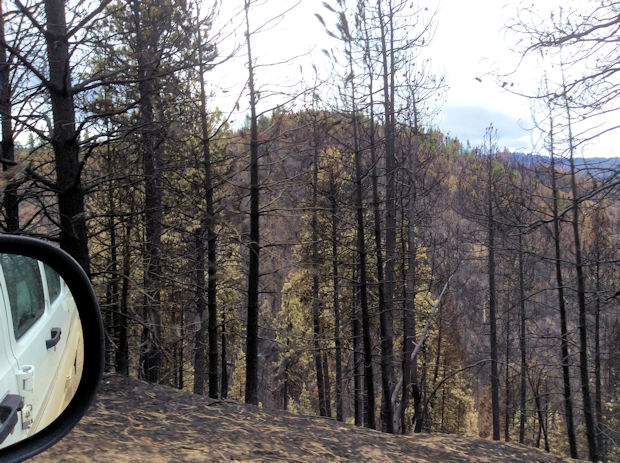
Burned trees right next to the road.

We drove on state highway 21 all the way to Boise, and it took us through the little historical town of Idaho City, which had been a gold mining town in the 1860s. It has board sidewalks and neat old brick buildings--very Old West. Apparently for a short time, this little place was the biggest city in the Pacific Northwest!

Old brick courthouse from 1800s is still the courthouse for the county.

Jack with one of the street gals he ran into on the boardwalk.


Monday, September 12, 2016

Fishing the Big Wood River

Lest we forget, 
here is the photo that Guide Andrew took of Jack with his large Silver Creek rainbow last Friday.

On Sunday morning we left the RV campground in Picabo and drove 7 miles to the small town of Carey, Idaho, where Carol had found a church to attend. As it turned out, the church at one time had been affiliated with Village Missions, the organization that sponsors our church in Oriskany, King Memorial, and many other churches in rural areas that can’t normally afford a full-time pastor. Larkin Memorial Community Church was friendly and unassuming. They obviously have a strong youth program, as about half the congregation of 40 or so were under the age of 17.
Larkin Memorial Church, Carey, Idaho.

After church we had a sandwich at the local gas station/diner (yummy freshly made sandwiches and salads) and then went back to the local outfitters in Picabo so he could buy new waders (we don’t want to risk another bout with hypothermia from his current leaky pair!). We saw Jack’s fishing guide Andrew Thomas at the outfitters with another group of fishing clients and we made a plan for him to meet us at 10 am Monday morning to fish the Big Wood River below Magic Dam, in his drift boat.

[Jack’s story of fishing the Big Wood River follows:]

“Trout Unlimited’s Guide to America’s 100 Best Trout Streams” by John Ross is the book I have used since it was published in 1999 as my “bucket list” of trout streams in America. When Carol and I started our current Epic Journey, I had 11 trout streams left to fish. Idaho has five of the Top 100 trout streams and I had already fished two. Last Friday I checked off Silver Creek and today I checked off the Big Wood River. ("Checked off" means I caught at least one trout in a stream.)

Tucked away in the book’s description of the Big Wood River is two sentences that read, “Below Magic Dam is a short tailwater that holds some of the biggest fish in the river. Despite heavy brush, the tailwater is well worth the effort.” I happened to mention this to Andrew, my guide on Silver Creek last Friday. Andrew said, “There are big fish in that stretch, but you can’t wade-fish the best part. I have a boat we can use to drift-fish that section if you want to try fishing there. I am available on Monday, but we need to find out when the dam owners are planning to stop the flow in the river.”

Andrew had already put me into fish on Silver Creek and although I didn’t quite understand about what he meant by the dam owners stopping the flow into the river, Carol and I signed up for a half-day of guided boat-fishing with Andrew. Andrew arranged to meet us at 10 am Monday at our campsite. The wind was very strong when we camped Sunday night. By the time we arose on Monday morning it was cloudy with a 70% chance of rain.

Andrew arrived early and said the dam owners had cut the flow in the river back a little, but that should not affect our day of fishing. I rode with Andrew while Carol followed in our RoadTrek so we would have a vehicle at the takeout point.

The three of us then drove in Andrew's truck to the site of the dam. The scenery was gorgeous. The whole area was covered by lava rocks and the canyon where we would drift-fish was lined on both sides by lava boulders, some the size of an elephant. Andrew spotted another two flyfishers already in the water in what looked like a raft (not allowed, Andrew said) but turned out to be a guide with his client using tubes to float the river (they are allowed). As Andrew launched his boat it began to rain. We quickly added more clothing, waders and rain gear.

Jack (left) and Andrew ready the boat. Note spillway on right.

Andrew rigged up a flyrod for nymphing and the three of us jumped in the boat. Water was being released from the bottom of the dam through what looked like a 6- or 8-foot diameter pipe which shot the water out into a large pool with a thunderous roar. We quickly passed a set of exciting rapids and I began to fish. Andrew clearly knew where the fish were lying in this stream. He directed me to place the nymphs on the right or left of the boat as needed. It was not long until I hooked into a hard-fighting rainbow. As I recall, Andrew said, “Little fish.” But it did not feel so little to me as it fought hard and when I got him to Andrew’s net, he looked to be at least 16 inches or so. “What did you mean by ‘little fish’?” I asked Andrew. “There are a lot bigger fish than that in these waters!” he replied.
Jack's first  "little" rainbow trout.

The largest trout I had ever caught so far was a 21-inch brown trout in the Henry’s Fork of the Snake River about 10 years ago, and I thought that was a big fish. We stayed in the first pool a while and I caught one or two smallish fish and then I hooked into a really big fish! I could tell it was big by the way it pulled on the line, bent the rod almost in half, and stripped line off my reel several times. After a long fight I got the largest fish (a rainbow weighing around 4 lb and measuring probably 24 inches) I had ever caught. High-fives with Andrew as I acknowledged that the earlier trout was indeed small by comparison.

Jack trying to bring the fish to the net. Note the bend in his flyrod.

Jack's big rainbow trout in the net.

The big rainbow in hand. Andrew on left, Jack on right. It's raining hard. What a beautiful fish!

While I continued to fish Andrew pointed out a peregrine falcon sitting at the top of a nearby tree. It was a beautiful sight along the lava rock-strewn banks of the river.

A few more strikes and misses and then a strange strike. At first I thought I had on a small fish, followed by a large tug on my line. A hard-fighting fish which stripped line off my reel swam deep and downstream. We could not see the fish as I tried several times to get it to the net. After maybe 5 to 6 minutes of fighting with the fish, I wondered whether he would play out before I did. I finally got him to Andrew’s net. It was the largest brown trout I ever saw. Easily 5 pounds and about 25 inches. Andrew and I were beyond ourselves as Carol snapped pictures. I could not believe in just around two hours of fishing I had not one, but two of the largest trout I ever caught!

Another big fish on.

Get the fish to net.

Two happy fishermen. A very big brown trout.

As we drifted further downstream the weather changed. It was still raining but now it was getting colder. I had on woolen gloves with finger-tip cutouts, but Andrew, who managed the oars, had no gloves on. Either I was getting cold or the weather changed the fishing, but I seemed unable to hook up with more fish, despite a few more strikes. We spotted a sizable bird in a tree and Andrew identified it as an American bittern. A little further downstream and I stopped getting any strikes. No strikes and getting cold, I suggested we stop fishing. Andrew rowed the short distance to the takeout.

As we entered the takeout area, we flushed out of the trees a large owl which we could not identify. I waited with the boat while Carol and Andrew drove back in the RoadTrek to the put-in area to fetch Andrew’s truck and boat trailer.

By the way, Andrew explained what was going to happen to this wonderful stream and the trout in it. On Thursday, flow to the creek will be stopped. Some of the trout will survive in the deeper pools and grow to be fished next year.

After loading up we drove to Bellevue to have a hot late lunch (or maybe we should call it an early supper) with Andrew, look at Carol’s great pictures and bask in the glory of one of the finest fishing days I ever had!

[Carol’s two-cents worth: A really fun time drifting the river and watching Jack catch spectacular trout, despite the chilly rain (which probably helped the fishing anyway). Andrew is a very knowledgeable guide who goes above and beyond the call of duty (and it also helps that he’s a Virginny boy and Va. Tech grad!). We’re now back at the campground, the rain has stopped for now, and we had a beautiful rainbow in the sky this evening, the perfect bookend for the beautiful one that Jack caught this morning!]

View from our camp as sky begins to clear. Another beautiful rainbow!

Sunday, September 11, 2016

Fishing Idaho's Silver Creek

Known by many Idaho guides as the graduate school of fly fishing, Silver Creek is a spring creek flowing out of aquifers into a desert region that runs north and south of US 20 near Picabo, Idaho. In the 1940s and 50s this stream became one of the most important fishing addresses in the world. Affluent anglers made annual pilgrimages to the area and, as was the custom of the day, took record sized fish from the waters to be mounted on walls or for memorable photos. As happened on most eastern trout streams, the wild fish in Silver Creek dwindled in numbers.

Fortunately Ernest Hemingway moved into the area and in 1975 his son Jack led a group of sportsmen who bought up precious land and turned much of the river into Nature Conservancy land now known as the Silver Creek Preserve. The wild fish came back under fly fishing and catch and release only rules established by Hemingway as a member of the Idaho Fish and Game Commission.

I was well aware of the difficulties in fishing spring creeks, having fished other Top 100 trout streams such as the Retort Spring Run in Pennsylvania, Hat Creek in California and the Armstrong’s and Nelson’s Spring Creeks in Montana. The basic problem in fishing spring creeks is they are full of natural food in the stream. That’s why the trout get so big and that’s why they look at your pathetic fly every which way and refuse it. The streams are crystal clear and the bottoms have long wavy grasses. So the trout can easily see you and not vice-versa.

So how does one catch these fish? Long leaders (15 feet and longer), fine leaders (7x about the size of a fine hair from your head), tiny flies you can hardly see, fly drifts that present no drag, downstream presentations, etc. You get the picture?

So even though I had caught spring creek trout before, to be honest I wondered if I would catch one on this river. So I do what I always do in these situations, I get a guide.

His name is Andrew and he was a 2012 graduate of Virginia Tech with a bachelor’s degree in Business Administration. Ok, so I knew we were going to hit it off and I knew he had to be good to give up a career in Business Administration to become a trout fishing guide in Idaho.

We met Andrew at the fly shop in Picabo at 1:00 pm and headed off to the Silver Creek Preserve. Carol followed us in the van because she wasn’t sure she wanted to watch me fish for six hours in the sun. “Did you like tubing?” Andrew asked. “I know what it is and have watched others tubing, but I haven’t done it and I’m willing to try.” So off we go walking along a path in the knee-high grass with Andrew carrying both tubes, me with Andrew’s 10 foot, 4-weight, $900 Scott rod, and Carol behind me.

A quarter-mile later Andrew shows me how to get into my tube. Now you must realize this water is cold (50-55 degrees F). I have on my waders and a pair of warm socks, but still it’s not like tubing Craig Creek in the summertime back home. Andrew ties on a 15- to 18-foot leader and a tiny fly that I can hardly see when it hits the water. Carol heads on walking downstream while trout rise all around us. Fortunately the wind is gentle but even a gentle crosswind makes casting a 15-18 foot leader difficult. But I’m not too bad. I get the flies to where Andrew asks me to place them most of the time. No takers. Not only that, my casting has put down all the fish that were rising.

Andrew (guide on the left) and Jack (on right with rod in hand)

OK, so it takes me awhile to warm up and Andrew is patient. I take comfort in knowing that Andrew has seen much worse fly casters than me. Suddenly a fish rises to my fly and takes it. I hook him, but he’s off just as fast as he got on. Andrew’s happy because he knows he found an imitation fly that matches what the trout are eating.

Then the trout stop rising. We move a little downstream where they are rising again…sporadically. Andrew changes flies. I get some takes but no hookups. Then a rainbow grabs my fly and takes off. He fights hard and runs my reel. We land him. To my surprise he’s smaller than I thought he was. He’s around 9 inches and fought like a 12 to 13 inch trout. Andrew agrees that the trout in Silver Creek are hard fighters.

Then we seem to go into a period when no trout are rising. Andrew tries everything, I get good drifts, but nothing. Andrew puts on nymphs, nothing. Andrew asks if I’m willing to try streamers (minnow and damsel fly imitations). Andrews leaves on the long leaders, which makes casting more difficult because of the wind resistance of the streamer. I get strikes but no hookups. Andrew takes off the long leader and puts on a shorter leader.

Several casts later I get a strike and when I set the hook it feels like a log. Suddenly the log bursts out of the water in front of me. It’s the biggest trout I have ever had on. He takes another leap. Carol who is on the shore near enough to see it jump thinks it’s the biggest trout she ever saw. The trout runs my reel, I keep my rod high and keep on the pressure. The trout makes another gigantic leap. My line goes slack. I look at Andrew, he’s as disappointed as I am. I asked what I did wrong. He says, “You did nothing wrong. The trout just did what was right. That’s how he got to be so big.” Andrew’s happy, I finally got to see just how big the trout can be in Silver Creek.

Further downstream I hook into another rainbow. To my surprise he fights hard but doesn’t take to the air. I figure it’s a brown trout. That’s usually the way they fight. But no, it’s a rainbow maybe 15 inches. Andrew snaps a photo of me holding the fish.

Fish on! Jack holds rod high as Andrew maneuvers in with a net.

We fish down to the Kilpatrick Bridge where we have to take out. I’m tired and cold. Andrew wants to fish more, but I say no. Carol walks back with Andrew to get the cars. I begin to shiver and my teeth chatter. No doubt I am very cold—probably somewhat hypothermic. When Carol arrives I climb into the van and take my waders off. I am soaked from the chest down. My waders had a leak and I didn't notice it until I stood up out of the water into a breeze. Drying off quickly and putting on warm clothes and a heavy jacket — and drinking some hot tea — brought me back to normal. It’s great to have a wife who is a nurse, and a guide that put me into fish on Silver Creek!

By the way, Carol took the following photos of fish near the edge of the bank as she walked along.

This trout is about 15 inches long. Note green grass growing on bottom.

Note shadow cast by the sun. The trout is probably in 3 feet of water.

This trout is also casting a shadow on the bottom. 
Note green grass where trout hide when you are fishing for them.


Thursday, September 8, 2016

Lots to see and do in Idaho!

We stayed at The Meadows RV park for the 3 nights of Labor Day weekend, waiting for the crowds to subside. The park was full of RVs, lined up right next to each other like on a city street--not our favorite type of RV park. (This is the only RV place with full hookups in the Ketchum area.) One good thing about this place is that a nice bike trail and the Big Wood River--one of the rivers on Jack's list to fish while here--run right by the campground, so that was convenient. We walked down to the river access and Jack fished for several hours while Carol took photos and did some birdwatching. At first, nothing seemed to be biting, but then he got into a hole where he got a few strikes. He had one fish on, but it broke off. He'll be fishing this river again. It's a picture-perfect trout river. It started raining right at the time he quit fishing and we made it back to the RoadTrek just before the downpour. It rained most of the night, and when we got up in the morning there was a dusting of snow on the hill in front of the campground! It disappeared quickly, but Brrrrr.....

I fished and fished and fished. Nary a strike. 
In the last hole with a heavy crosswind I had several strikes on a small mayfly. 
Finally one broke my 7x leader as it started to rain.

We left The Meadows on Monday with the plan being to drive a big rectangular loop of scenic byways and see some of the spectacular sights of the area, while scouting out likely fishing and camping spots. The central Idaho scenery is amazing--it changes so rapidly, you never know what's going to be around the next bend: lava flows and volcanic craters, peaceful ranches set against beautiful mountains, 12,000-ft high snow-covered peaks, lakes, tumbling rivers--they got it all! The first scenic byway is called the Peaks to Craters Scenic Byway. We stopped at a fishing outfitters about 40 miles down the road and Jack talked to a knowledgeable guy about different fishing spots. He decides to hire a guide to fish a couple of the streams, as they can be tricky, especially the famous Silver Creek. So he's set to fish on Friday with Andrew, who happens to be from Virginia and is a Virginia Tech grad!

We continue on our way and get to Craters of the Moon National Monument visitor center in late afternoon. We watch a couple of their movies and Carol gets her National Park Passport book stamped. This place is filled with lava fields, spatter cones and cinder cones from numerous volcanic eruptions over eons. We spend the night at the Craters of the Moon KOA--one of the nicer KOAs we've stayed at. Idaho people in general seem nicer than average, and the woman who owns and runs this KOA is a good example. She provides a FREE yummy waffle and coffee breakfast to her campers! We never had a free breakfast at a KOA before--free coffee, maybe.

Mountains in the sky? Look closely and you will see the tops of the mountains looming ahead.

We depart Tuesday morning, continuing on our scenic drive--and it lives up to its name. The mountains keep getting bigger and more spectacular, with many snow-covered peaks coming into view. We stop at the sign for Mount Borah, the tallest peak in Idaho. They had a major earthquake in this area in 1983--apparently the whole valley sunk 9 feet and the mountain rose 6 inches! Quite a bit of damage was done to some of the small towns in the area. There were 2 deaths--two kids walking to school and a building fell on them. Very sad.

Snow-covered mountains.

Mount Borah, the tallest in Idaho. Facts below.


A major earthquake in 1983, that sank the road we were driving on by 9 feet.
And raised the highest mountain in Idaho another half-foot.

One weird and somewhat unsettling thing about driving this section of the Byway: within about 10 minutes we had TWO rocks hit our windshield and leave chips/cracks. One of them went all the way through the window and left a few glass shards on the dashboard! When we were talking about this to a guy at a fishing outfitter in the next town, Challis, he said, "Welcome to Idaho!" (We decided to hold off getting these fixed till we get out of Idaho...)

Heading into Challis, we saw a sign for "Challis Hot Springs: B&B and RV Camping" -- sounded like the place for us! After doing some provisioning in Challis, we headed back to the Hot Springs. What a lovely spot! It's a ranch that's been here since the 1870s. They have two pools, one hotter than the other, sitting over a hot springs. The water is contained in concrete pools inside a wooden structure, but the bottom is nice, rounded, small river rocks that feel good on your feet. Lovely place to soak! We met two couples while soaking and chatted for a long time. Our campsite was by the Salmon River, so Jack went down to fish for a while when we got there, but didn't catch any. He was ready to declare "no fish in this stretch of the river" but then an osprey, or some kind of fish hawk, flew overhead with a nice size trout in its talons. So there. Had a quiet night and then another quick soak in the morning before leaving on Wed. morning. Hated to leave this peaceful spot!

Our campsite with no one around and the Salmon River on the right.

A calm spot in the Salmon River looking upstream.

The fantastic Challis hot spring pool with a cobblestone bottom. 
At about 101 degrees, it was very hard to get out of this pool.

The drive just kept getting more and more scenic! Jack stopped at a few likely streams to scout for trout. Our goal for the day was Redfish Lake, which has several nice campgrounds. The name "Redfish" comes from the sockeye salmon which used to migrate from the ocean into the lake in such numbers that the lake turned red (the male salmon turn bright red during breeding). They are endangered now but attempts are being made to bring them back in larger numbers, which seem to be somewhat successful. The Sawtooth Mountains forming the background of the lake are jagged, glacier-carved mountains--spectacular! These are glacial lakes up here, beautifully clear. We secured a campsite along the lake and then drove down to the nearby Fish Hatchery, which is central in the effort to bring back both the sockeye and the native chinook salmon to the lakes and streams here. We saw salmon spawning in the Salmon River which runs by the hatchery--also some dead salmon in the water. They die after spawning--after making an incredible 900+ mile journey from the Pacific, including getting past 8 dams on the way.

Carol in the morning at Redfish Lake.

Salmon spawning in the the river.

Had a peaceful night and then went back to the hatchery in the morning to see them release salmon from their traps. The hatchery already has their quota for this year, but they are still measuring and weighing the salmon coming through their weir, and moving them upstream to spawn. These are some huge and beautiful fish. Salmon fishing used to be a big thing in Idaho many years ago, but then construction, dam-building and other environmental tragedies took their toll--one year in the 1970s only one salmon returned here. They called him Lonesome Larry. But then some folks got motivated and came up with ways to repopulate and hopefully salmon will be returning in greater and greater numbers!

The trap is opened at 9 AM. 
One ranger climbs into the trap and nets each salmon, one at a time.
The one jumping doesn't like the net.

The netted salmon is passed to another ranger who weighs it and determines its sex.
 The female ranger on the left records this information.

The ranger shows us the salmon before placing it into another holding tank.

One ranger even let us pet a salmon.

We backtracked a little after our salmon adventures, as Carol wanted to try out another hot springs, called Sunbeam hot springs. Hot spring water at 140 degrees pours out of the mountainside into the Salmon River. Folks have rearranged river rocks to form pools at various temperatures. A lovely place to soak, very different from the Challis developed pools, but equally refreshing and relaxing! W then drive back south toward Ketchum, passing through the rustic little western town of Stanley.

Carol waving in the riverside hot spring. The Salmon River roars by in the background.
Wonder what the salmon think of this as they swim upriver?

The countryside around the little town of Stanley, Idaho, north of Ketchum. LOTS of log houses and buildings here!

We drove through Ketchum this afternoon and ate a very delicious hamburger, but the town looks a little too "yuppified" for our tastes. Lots of rich people here. We continued on down toward the fly shop where Jack will meet his guide tomorrow, and we're camping in a free campground at another fish hatchery right now. Tomorrow, Jack goes to the Graduate School of Flyfishing -- Silver Creek.

Beaver dam on the upper reaches of the Wood River, About 20 miles north of Ketchum.


Saturday, September 3, 2016

Ice caves and Idaho

On Tuesday, our last night at the Dinosaur National Monument campground, we sat outside and marveled at the night sky. We were rewarded by a dazzling shooting star that seemed to take several seconds to blaze its path across a big portion of the visible sky. Wow! We enjoyed this campsite--it was very quiet and had a good view of Split Mountain. We also attended a couple of evening programs put on by the rangers here, one on bats and the other on mountain men. If any of you saw the recent movie The Revenant, that mountain man, Hugh Glass, played by Leonardo Decaprio, was around here. The ranger told the "true story" about him, and it was actually pretty close to the movie. Very tough guy.

View of Split Mountain from our campsite.

On Wed. we drove west, heading for a small state park just southwest of Salt Lake City, called Camp Floyd. Jack was interested in seeing it, because Gen. Buford, a Civil War general of Battle of Gettysburg fame (a major character in the novel Jack is writing) had been stationed at this US Army camp for a couple of years. We stopped at a motel Wed. night just short of Camp Floyd, after driving through some awesome rocky canyons to get here. (Utah's scenery is jawdropping, no matter where you go.)

One awesome scene was a large waterfall along the side of the road.

On Thursday morning, we drove to Camp Floyd SP, only about a half hour's drive from the motel. They have a small museum with a movie in the old commissary building, which is the only original building left from Camp Floyd. Across the street from the museum is a restored old inn, which was used by the locals and the Army to house visitors during the time of Camp Floyd, which was 1858 to 1861, and for years after that as well, since the Overland Stage stopped here. This is an interesting footnote in American history. In 1857/1858, rumors were started that the Mormons here in Utah were rebelling against the laws of the US government. The Mormon militia had actually killed some non-Mormon immigrants but apparently didn't really have plans for a full-out rebellion. President Buchanan sent 3,500 troops (about one-third of the entire Army) to Utah to suppress the suspected rebellion. There were skirmishes and confrontations between the Army and the Mormon militia, called the "Nauvoo Legion," but no full-pitched battles in this so-called Mormon War. The Mormons harassed the Army as it marched into Utah, blockading roads and burning grass so they had no food for their animals, and destroying part of their supply trains. Tensions ran high, but casualties were few. Finally, the Army and the Mormons negotiated and the Army was allowed to build a camp here at Camp Floyd, a good distance away from Salt Lake City so as not to have the soldiers' immorality affect the good Mormons living there, and a non-Mormon was allowed to replace Brigham Young as governor of the territory. So the Army stayed here for a few years, forming what was then the third-largest city in Utah! They monitored the Mormons, and protected immigrants heading through the territory to other areas--and were basically bored stiff with nothing to do but drink and gamble--until they were recalled for the Civil War in 1861. The Mormons actually benefited from the Army coming here, as they were hired to make bricks and build barracks and other buildings for the Army camp and were paid in cold, hard cash, which had been in very short supply in Utah before the arrival of the Army. And when the Army closed the camp and left in 1861, several million dollars in buildings and equipment were sold to Mormons for $100,000!

The Camp Floyd State Park sign with Carol on left reading commemorative plaques.

Inside the museum. John Buford was a Captain in the U.S Second Dragoons (cavalry) at this camp.

Carol in front of the well-preserved old Stagecoach Inn.

After leaving the Park, we drove through Salt Lake City, which was huge and full of traffic--early Labor Day weekend travelers! (Grateful for HOV lanes...) We made it across the Idaho state line, and ran into a huge dust storm. Shades of the Dust Bowl! Fortunately we drove out of it after about an hour. It was kind of scary.

Reminiscent of the "Dust Bowl" days, The blowing dust hides parts of the mountain ahead.

We stopped for the night at a sleepy little Mom and Pop RV campground and had a quiet night's sleep. The rates were reasonable too. (Don't think we mentioned before that we're trying to achieve an average nightly housing rate of $25--we're pretty close at this point, especially after 4 nights in Dinosaur at $9/night.) The Mom and Pop place was only $27, which is about as cheap as you can find full hookups at private campgrounds nowadays.

We drove on Friday morning to reach the fishing area that Jack has been salivating over, which is near Ketchum and Sun Valley. We passed through a long stretch of lava-covered plains with lots of nearby spatter cones and shield volcanos. This place had active volcanos several thousand years ago--all are apparently dormant now. [Note to Ninette and Vickie: looks a lot like the Big Island, except with sagebrush!] We saw a sign for "Ice Cave" and it sounded intriguing, so we stopped. The cave was a partially collapsed lava tube that maintains a 20-ft thick layer of ice in the bottom. We took the tour (after going back to the van to get our jackets) and it was great. Back in the 1940s they used to do ice skating exhibitions down there! And according to our guide, a high school student named Gabe, the nearby town of Shoshone had the first cold beer in the area due to harvesting the ice from this cave. Why is ice in here even when the temperatures above can be 90+ degrees F? It has something to do with the air flow. Gabe skated on it. It's like a big glacier down there--weird!

This dinosaur greeted us on the way to the Ice Cave entrance.

As we entered the Ice Cave this bench was there to remind us that the walk back up was tiring.

Our guide Gabe stops to explain that steep steps are ahead as we enter the lava tube.

Deep within the lava tube our guide Gabe walks on the ice to prove to us it's very thick solid ice.

On the way back out of the ice cave, Jack makes use of that rest bench. (Note jacket he's wearing.)

We headed on toward Silver Creek, one of the streams Jack plans to fish. He wanted to get a first look at it. While he was watching the many trout lining up below a bridge looking for bugs, Carol took a short hike to see the Hemingway Monument, a carved stone in a quiet place along the banks of the creek. Hemingway lived here in Ketchum for a good part of his later years, loving the mountains and the hunting and fishing, and in fact he killed himself here in 1961--not necessarily a good advertisement for the place but I guess he had "issues." We need to read more about that.

Commemorative Stone to Hemingway.

Silver Creek is known as the graduate school for fly fishers. (You have to be a good fly fisher to catch the trout here.) The creek was once the most famous trout stream in the US. 
It has since been surpassed by Henry's Fork of the Snake River, but it's still world-renowned.

We're now ensconced in one of the few private RV parks in the Ketchum area with full hookups. We're waiting for the holiday weekend -- and all the people -- to go away!

When Carol went grocery shopping (her turn now to cook) Jack sat and waited in our air-conditioned van. A dog barking in the pickup next to him looked strange. 
Then Jack realized the dog had on sunglasses.