Saturday, June 22, 2013

Leaving the Rockies Behind


June 21, 2013

We have a quiet night in the van parked in Kelly’s driveway. Todd had to leave for work about 5:30 am, but we didn’t hear a thing. We get dressed and have breakfast in the van.  Kelly and Laura are already up and busy. I ask Kelly if I can do a load of laundry—I love her spacious laundry room! Lots of room to hang up clothes and get organized.

We visit awhile with Kelly and Laura. Laura is a quilter, and Kelly has taken up sewing big time, coming up with lots of cute patterns for items like baby bibs, doggie jackets and other things to sell on eBay eventually. She chooses wild and colorful fabrics and her items look very professionally made. I think she’ll do well with these.

Yesterday Kelly told Jack and me about a nearby natural history site called Dinosaur Ridge and said we shouldn’t miss it. Colorado is known for its fossils and this area was one of the earliest and best-known sites of major fossil discoveries, with both dinosaur tracks and bones. She told us her neighbor, DuWayne, a retired colonel in the Air Force, volunteers as a tour guide at the site and that he would probably be willing to give us a VIP tour. She called DuWayne and he said “Be ready at 1 pm! Bring hats, good shoes, sunscreen and water!” We figured we were in for a treat and that was indeed the case.

DuWayne met us outside a little before 1 pm, and we headed in his truck to Dinosaur Ridge. He stopped at the museum building to pick up some “props” and then we headed up the hill to the fossil sites. DuWayne is a fabulous, lively and funny tour guide. He is very active while lecturing and throws in lots of funny stories. He has a unique ability to tailor his “spiel” to the youngest and the oldest listeners at the same time. Very cool guy!
 

DuWayne, our Dinosaur Ridge guide.

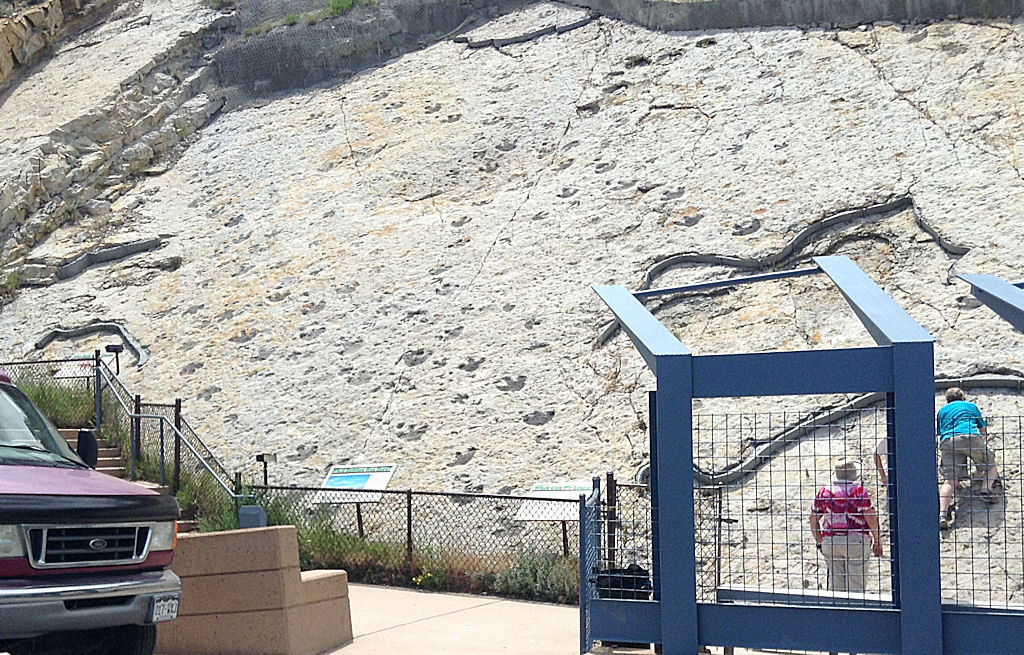
And the site was amazing. I believe this is the first time either of us has seen dinosaur tracks in place, where we were able to touch them. There are lots of tracks of various kinds, as it’s hypothesized that the area was a sea at one point (there are fossilized water-shaped ripples in some places) and that the dinosaurs walked through the mud and sediment that was left when the water receded. There were volcanoes in the area at one point as well that apparently affected the fossilizing process—the geology here is amazing, with many kinds of rocks. In addition to the tracks, many fossilized dinosaur bones have been found here as well, and some are still here. DuWayne showed us with a geiger counter that the bones embedded in the rock are slightly radioactive—the thinking is that the volcanoes emitted some radioactive material that then covered and seeped into the holes in the porous bones before they became fossilized, which left them radioactive.
 

Carol with her hand print in a dino's foot print.


Lots of dino tracks. Although the area is now inclined at about 45 degrees, it was once level marshland.

Mildly radioactive fossilized dino bones.

In addition to the fascinating fossils and geology, we also could see the Red Rocks Amphitheatre from the ridge, the open-air site of many great concerts (like our favorites, the Moody Blues) that we’ve seen on PBS television programs. Even the Beatles played here on their 1964 tour.
 

The famous Red Rocks Amphitheater

A final bonus was a sighting of a new bird for our list, the rufous-sided towhee (also called the spotted towhee), which DuWayne told us is relatively rare in this part of Colorado. It was a great tour and we really appreciate Kelly setting it up for us and DuWayne giving up his afternoon to inform and entertain us!
 

This was as close as Jack could get to the rufous-sided towhee.

When we got back, Jack and I decided to take off and get through Denver, since we want to keep fairly close to our driving schedule for our remaining week. We took some photos and said our farewells to Kelly, Todd and Laura. We hope Kelly and Todd will visit us soon in Virginia…. 
 

Kelly and Todd

Carol, Kelly and Jack


We made it through Denver at rush hour. (No thanks to me telling Jack the wrong instructions for one interstate ramp, which caused us to drive through city back streets for about 10 miles—at least we saw some of the older residential areas of Denver!) We finally got on I-70 east and as soon as we passed the Denver airport, the traffic slacked off and the terrain changed almost immediately to flat, flat plains/prairie. Lots of flat grazing land, and we saw several pronghorn antelope, which we hadn’t seen before on this trip. After driving awhile, we decided to stop at a motel and do some work, since we both need to catch up on our book projects.

Where we are:
 

We’re in Limon, CO now.

Bird species count: Vermilion flycatcher, turkey vulture, Bell’s vireo, *golden-fronted woodpecker, Say’s phoebe, northern cardinal, greater roadrunner, house finch, common raven, *northern rough-winged swallow, *summer tanager, *prothonotary warbler,  *yellow-breasted chat, *yellow-rumped warbler, northern mockingbird, mourning dove, cliff swallow, Mexican jay, black-headed grosbeak, black-chinned  hummingbird, Wilson’s warbler, *Scott’s oriole, chipping sparrow, house sparrow, lesser goldfinch, black-crested titmouse, acorn woodpecker, scrub jay, *western kingbird, white-winged dove, *canyon towhee, *Grace’s warbler, *zone-tailed hawk, *curve-billed thrasher, Bullock’s oriole, Gambel’s quail, great horned owl, black-throated sparrow, *cactus wren, ladder-backed woodpecker, white-crowned sparrow, brownheaded cowbird, Brewer’s blackbird, *pyrrhuloxia, hooded oriole, verdin, American st blog e and all the files uploaded. little wild iris. It'agebrush that we were riding over and through. Lupine looks crow, Anna’s hummingbird, dark-eyed junco, white-throated swift, Steller’s jay, mallard, common egret, brown pelican, western bluebird, loggerhead shrike, Audubon’s warbler, robin, Canada goose, black-billed magpie, red-winged blackbird, redtailed hawk, American dipper, *yellow warbler, tree swallow, osprey, mountain bluebird, peregrine falcon, green-tailed towhee, rufous-sided towhee

State count: 14 [Virginia, North Carolina, South Carolina, Georgia, Tennessee, Arkansas, Oklahoma, Texas, New Mexico, Arizona, California, Nevada, Utah, Colorado]  
     
Odometer count:
Surber, VA: 107,435
Limon, CO: 115,662  

Accommodations avg cost: 75 nts, avg $13.33/night

Friday, June 21, 2013

Driving to Denver


June 20, 2003

After breakfast we unhook from our connections and head up the road toward Denver. We are still in a very mountainous part of the Rockies and wonder how the drive will be—as it turns out, we will cross four peaks of over or close to 11,000 ft in our drive today! Our good ol’ RoadTrek handles them admirably, but sometimes it seems a little tired…

The first part of the drive, which is labeled as a “Scenic Byway” on our Colorado map, is up and over a mesa (flat-topped mountain) called Grand Mesa. We are not prepared for the sweeping beauty of this place. We enter a national forest as we start the long steep drive up the mesa, and the scenery changes from dry and arid hills to green, lush fields with wildflowers and then to quaking aspen groves, and finally to alpine meadows and slopes covered with tall spruce trees and other evergreens.

View from the top of Grand Mesa. Elevation about 11,000 feet. Note snow on top of mesa on left and large lake in middle.

The top of the mesa is close to 11,000 ft in elevation; since it’s flat, it has many small lakes on top. Jack and I stop at the visitor’s center on top and walk to one lake and see that it’s filled with trout, some feeding on the surface. I practically have to hogtie Jack to get him to leave, reminding him that we do have a schedule to meet today, since Kelly’s expecting us by suppertime.
 

Jack wistfully watching trout rising to take bugs off surface of lake.

 There are a few patches of snow lying around the visitor’s center, and Jack finally gets to make a snowball! 
 

Snowball fight anyone?

Grand Mesa is a magical place and we resolve to come back here sometime in future.

A note on Colorado wildlife: the highways and roads have plenty of signs to watch for wildlife, including deer, elk and moose, but the largest animal we’ve seen is a mule deer, and we haven’t seen many of them. We did see a marmot today, which is something like a groundhog, and we’ve seen lots of small mammals like chipmunks and ground squirrels. Apparently they only have black bear, at least in the areas that we’ve been camping, which is a relief not to have to worry about grizzly bears. Colorado does have a large elk population and they have reintroduced moose, which is protected as I understand it. Would like to see an elk or moose, but doesn’t look like it’s going to happen on this trip. 

The scenery changes dramatically again as we descend the mesa, becoming barren rocky crags. We enter yet another dramatic river canyon in our quest for Interstate 70 to Denver. The canyon seems to go on forever, with no signs for I-70, and we feel like we’re lost in its steep twists and turns—at places, the tall sides seem to tilt backwards over top of us. Finally, we come to a sign for I-70 and breathe a sigh of relief.

This section of I-70 is like none other that we’ve experienced on an interstate drive (except that Jack drove this section once before when he was by himself on a fishing trip, and he’s told me about it many times). It cuts its way through some of the most beautiful and steep sections of the Rocky Mountains. We pass through several tunnels and drive over steep grades; at one point our eastbound section (two lanes) of I-70 is down on a rocky ledge near a rushing river, while the westbound portion of the road is carved out of the rocky cliff about 75 feet above us. It must have been some job to design and build this road!

We pass by or near several famous Colorado ski resorts: Breckenridge, Aspen, and Vail being the most notable and sizable. We skied at Vail back in 1984, as a reward to me for completing engineering school at the University of Maryland. The place now looks nothing like we remember it. There are 3 or 4 exits off I-70 for Vail now—it seems to go on forever with condos and chalets filling the valley and crawling up the slopes.

A separate little “mini-highway” for bicyclists and hikers accompanies the interstate for many miles, through gorgeous scenery. Colorado is extremely biker-friendly. Almost every road has its accompanying bike trail, separated safely from the main road, but this is the fanciest one we’ve seen!
Our TomTom GPS hasn’t been working right for about a week—it’s getting very frustrating, so we decide to stop at a Walmart along the way and purchase a new one. This time we buy a Garman, which has a few different features that we’re interested in. Jack gets it set up, and it gives us good directions for getting to our friend Kelly’s home in Lakewood, CO, on the western outskirts of Denver.

We arrive a little after 5 pm and have a hug-filled and slightly tearful reunion (Kelly and Carol—Jack is more stoic). We haven’t seen Kelly for several years—she used to work with us in our book publishing in California (she still does some book production) and she’s visited us in Oriskany and we’ve visited her in other places. (For those Oriskany blog readers, Kelly helped us with the printing of the original Oriskany cookbook.) She now lives with her husband Todd in Lakewood. The three of us (Kelly, Carol, Jack) go to dinner together, while Todd goes to his bowling team practice, taking Kelly’s cousin Laura who’s also staying here for a bit, so the three of us can catch up. We have a LOT to catch up on, and the conversation continues on into the night on Kelly’s comfy back patio. A very pleasant reunion—it’s good to see Kelly looking so well!

Kelly at home.

 We’ve parked our RoadTrek in Kelly’s driveway and retire there for sleeping around 11 pm.


Where we are: 

As you can see, we loved Colorado. I fished 7 streams (name labeled in red) and caught trout in each one. Largest trout I caught was in the Gunnison River near Almont, CO. I could have caught a trout on a dry fly in the lake on top of Grand Mesa but Carol wouldn't let me.

Bird species count: Vermilion flycatcher, turkey vulture, Bell’s vireo, *golden-fronted woodpecker, Say’s phoebe, northern cardinal, greater roadrunner, house finch, common raven, *northern rough-winged swallow, *summer tanager, *prothonotary warbler,  *yellow-breasted chat, *yellow-rumped warbler, northern mockingbird, mourning dove, cliff swallow, Mexican jay, black-headed grosbeak, black-chinned  hummingbird, Wilson’s warbler, *Scott’s oriole, chipping sparrow, house sparrow, lesser goldfinch, black-crested titmouse, acorn woodpecker, scrub jay, *western kingbird, white-winged dove, *canyon towhee, *Grace’s warbler, *zone-tailed hawk, *curve-billed thrasher, Bullock’s oriole, Gambel’s quail, great horned owl, black-throated sparrow, *cactus wren, ladder-backed woodpecker, white-crowned sparrow, brownheaded cowbird, Brewer’s blackbird, *pyrrhuloxia, hooded oriole, verdin, American st blog e and all the files uploaded. little wild iris. It'agebrush that we were riding over and through. Lupine looks crow, Anna’s hummingbird, dark-eyed junco, white-throated swift, Steller’s jay, mallard, common egret, brown pelican, western bluebird, loggerhead shrike, Audubon’s warbler, robin, Canada goose, black-billed magpie, red-winged blackbird, redtailed hawk, American dipper, *yellow warbler, tree swallow, osprey, mountain bluebird, peregrine falcon, green-tailed towhee

State count: 14 [Virginia, North Carolina, South Carolina, Georgia, Tennessee, Arkansas, Oklahoma, Texas, New Mexico, Arizona, California, Nevada, Utah, Colorado] 
     
Odometer count:
Surber, VA: 107,435
Lakewood, CO: 115,519 
Accommodations avg cost: 74 nts, avg $13.12/night

Wednesday, June 19, 2013

Yet Another Gorgeous Colorado River…


June 18-19, 2013

Tuesday
We leave our beautiful campsite on the Gunnison and head up to the tiny town of Almont in search of breakfast and wifi, so we can blog and check our email. The breakfast turns out to be greasy but tasty and it comes with great wifi. Since Jack fulfilled his Gunnison River trout goal so quickly, he decides he wants to check out some of the other world-renowned trout streams in the area, even if they aren’t on his Top 100 list. He heard good things about the Lake Fork River, and wants to fish it. So after a whirlwind souvenir-buying spree in a little gift shop (Carol doing the souvenir buying while Jack works on the blog), we head off looking for the Lake Fork River and a suitable camping spot.

More beautiful scenery along the way—it’s amazing how the Colorado scenery can completely change from one bend in the road to another. We finally come to a BLM campsite and decide to make it our home for the night. For those who may not know, the Bureau of Land Management (BLM) is a U.S. government agency that oversees all the public lands in the U.S. that don’t fall under a national park or national forest, which are managed by other agencies. Most of these public lands—millions of acres—are in the West and are leased to ranchers for grazing or to mining or other companies to extract the “resources.” Some of the areas are also open to recreation and primitive campsites are provided by the BLM at some sites, like the Lake Fork River. The campsites are basic but usually well-kept, like this one: we find a level, shaded site right by the river. Our cost for a night of camping here in a pristine wilderness: $2.50, which is half price due to our Golden Ager national park pass.

Jack quickly grabs his fishing rod and heads for the river; I putter around in the van, thinking about working on my latest book project or going birdwatching. I saw some bluebird boxes on fenceposts along the gravel road driving in, and I’m hoping to spot a mountain bluebird for our birding list. (At last count, we only had 66 birds on our list for this trip, so we need to step up our birding activities if we’ve going to reach our goal of 100 species of birds identified!)

I decide to go check on Jack—read his section below for what happened next.

After that excitement, I grab my binoculars and start walking down the road. Sure enough, as I creep up on the nearest bluebird box, about a half mile away, I see a pair of mountain bluebirds flying in and out of the box, obviously feeding their young ones. These bluebirds are a sort of turquoise blue and don’t have the rusty red breast of our Eastern bluebirds. A very attractive bird and I’m glad to “bag” it for our list.

There’s only one other group of campers at our campground and they’ve been off somewhere since Jack and I arrived. They return around suppertime and I introduce myself to them: Linda and Ron, a retired couple from Phoenix, Arizona and Linda’s brother Rex. They are friendly and invite us to join them later at their campfire, which we do after our spaghetti supper. We have a congenial time telling camping, fishing and traveling stories and watching the fire.

Next, Jack will fill in his fishing tales.
I wanted to take a look at the "Lake Fork of the Gunnison" River because it originated in a lake (Lake Cristibal near Lake City, CO) and emptied into another lake (Blue Mesa Reservoir that dams the Gunnison River downstream of Gunnison, CO). I reason that just maybe I would find some dry fly action.

It takes us about an hour to get to a nice BLM campsite that's right next to the river. On the way I see no trout rising to take flies on the surface. Oh, well, I tell Carol I'll not suit up, I'll just tie on Big Gaudy with the purple prince dropper. Carol says she's going to birdwatch or work on her book, and I head down where I can stand on a few rocks with my regular shoes. I cast upstream and almost immediately Big Gaudy goes under the water. I tighten my line and set the hook in a large trout that runs downstream with my reel screaming. The trout pulls hard and has the heavy river current working for him. I fight him for about 3 minutes, but can't get him to turn upstream. I figure he must be a big brown because he never jumps out of the water (like rainbow do). He's on the little purple prince and pulling very hard. Carol hears the splashing and comes down to watch.

At this point the tip of my rod is almost bent 180 degrees. Suddenly, the trout gets off and my line springs back into a tree behind me, creating a big tangled mess. I figure he broke my line where it is tied to the purple prince. As I start cutting out the tangles, I note the purple prince dangling in the tree next to Big Gaudy. The trout had pulled this small nymph out of his mouth. Ouch! With Carol's help, I cut off my flies and tie on a new leader. I tell Carol that I brought down  my iPad and laid it in the grass. Just in case, I asked her to stand by with my iPad while I cast once more.

One more cast upstream and I hook another trout. This one immediately jumps out of the water and runs downstream. He's not as big as the first trout, but he's a fighter. This time Carol is able to take pictures all during the fight. I land this trout ( a rainbow) and Carol and I both decide that we should definitely stay here for the night. Where else, we agree, can you find a trout river where you catch two trout after two casts?

This is the one that didn't get away. Note that I am not in my waders and boots.


In the net.


In hand.

As it turns out, I fish for another two to three hours. I hook three more trout and net one. I make a heck of a lot more casts than just three more. Fishing has a way to bring you back down to earth just when you start thinking you might be getting very good at this sport.

Wednesday
Where is this week going? Seems like time is speeding up as we get nearer to our deadline for returning home (by June 30). It’s been a chilly night, colder than usual and I get up in the middle of the night to put a blanket under me as well as over me—our air mattress is usually very comfy but tonight it feels like a block of ice underneath me (Jack is snoring away and doesn’t seem to notice the cold). 
 

Having breakfast with the Lake Fork river in the background...still sleepy after cold night.

After breakfast, we rearrange a few things in the van this morning, to make it less crowded (we plan to do some remodeling after this trip). We say goodbye to our friends at the next campsite and head off to explore Black Canyon of the Gunnison National Park, about 60 miles northwest of here. First, we need to buy some propane since we’re almost out, and find an RV campground to spend the night, since we need to empty our tanks. Jack has bought a new hookup for our tank emptying process that he thinks will work better, and we want to try it out.

We head for Montrose, the only town of any size near the national park, and succeed in finding both propane and a great RV park, in a quiet, green oasis practically in the middle of town. Then we head for the canyon.

We’ve seen a lot of marvelous canyons on this trip, and the Black Canyon is certainly one of them. With sheer 2000-ft walls and a roaring river below, it’s jawdropping to see. We drive around the south rim, stopping and taking short hikes to various viewpoints, each with its special geological feature or sweeping vista. 
 

Carol with the visitors center in the background. At this point the Gunnison River is 2300 feet below down a sheer cliff.


This photo hardly does this canyon justice. The top of the canyon wall is half a mile away. The tiny stream you see at the bottom is the Gunnison River, 2300 feet below the canyon rim. 

Click here for a panoramic view of the Canyon.

We’re especially eager to spot a peregrine falcon, which we’ve been informed are nesting at a certain viewpoint, the Painted Wall. We need it for our list, and we also have seen some great documentaries on this bird and would like to see it in flight. 

We luck out—as we approach the spot where the falcons are supposed to be, we spy a pair of them wheeling and circling overhead. We don’t get to watch them for long, but long enough to identify them. I also spot another new bird for our list, the green-tailed towhee, an olive-green bird with a rusty red cap. Good! We’re homing in on that 100-bird count!

Back at the campground, we hook up the new tank-emptying equipment and have a successful dump—no pun intended.

Tomorrow we’re driving to Denver, where we’ll see our dear friend Kelly, who we haven’t seen for several years!

Bird species count: Vermilion flycatcher, turkey vulture, Bell’s vireo, *golden-fronted woodpecker, Say’s phoebe, northern cardinal, greater roadrunner, house finch, common raven, *northern rough-winged swallow, *summer tanager, *prothonotary warbler,  *yellow-breasted chat, *yellow-rumped warbler, northern mockingbird, mourning dove, cliff swallow, Mexican jay, black-headed grosbeak, black-chinned  hummingbird, Wilson’s warbler, *Scott’s oriole, chipping sparrow, house sparrow, lesser goldfinch, black-crested titmouse, acorn woodpecker, scrub jay, *western kingbird, white-winged dove, *canyon towhee, *Grace’s warbler, *zone-tailed hawk, *curve-billed thrasher, Bullock’s oriole, Gambel’s quail, great horned owl, black-throated sparrow, *cactus wren, ladder-backed woodpecker, white-crowned sparrow, brownheaded cowbird, Brewer’s blackbird, *pyrrhuloxia, hooded oriole, verdin, American st blog e and all the files uploaded. little wild iris. It'agebrush that we were riding over and through. Lupine looks crow, Anna’s hummingbird, dark-eyed junco, white-throated swift, Steller’s jay, mallard, common egret, brown pelican, western bluebird, loggerhead shrike, Audubon’s warbler, robin, Canada goose, black-billed magpie, red-winged blackbird, redtailed hawk, American dipper, *yellow warbler, tree swallow, osprey, mountain bluebird, peregrine falcon, green-tailed towhee

State count: 14 [Virginia, North Carolina, South Carolina, Georgia, Tennessee, Arkansas, Oklahoma, Texas, New Mexico, Arizona, California, Nevada, Utah, Colorado]
      
Odometer count:
Surber, VA: 107,435
Montrose, CO: 115,215

Accommodations avg cost: 73 nts, avg $13.25/night