Wednesday, June 26, 2013

Back in Mugsville


Jun  24-26, 2013
                                                     
No, we haven’t fallen off the face of the earth. We’re in Missouri right now, making our way toward St. Louis from a little town called St. Joseph, as we detoured to visit a couple of more state parks that were supposed to be good birding spots.  No go, although we saw some pretty spots. Must be the wrong time of year—too late for migratory birds and most are already done with their nesting. We’re only adding onesie/twosie’s to our bird count now—most of the birds we’re seeing are already on our list.

One lovely birding spot overlooked the Missouri River where the Lewis and Clark expedition stopped to rest after heat exhaustion due to the hot and muggy weather.

The reference to “Mugsville” in the title of this blog refers to the humidity. Somewhere about the middle of Kansas things went from arid and fairly cool to muggy, hot, and humid—our usual eastern summer weather. A few thunderstorms are around too.

We decided to stop at another Motel 6 in St. Joseph (new Scandinavian décor again) for a night, so I could do a little work on the book, and then for my birthday on Tuesday we planned to have a celebratory lunch at a nearby Red Lobster and then drive on up the road a piece, to Cairo, MO, to see if I could locate the grave of my great-great-grandfather, James Washington Surber.

Well, that was the plan. But then I got hit by a stomach bug Monday evening, so we ended up staying another night at the Motel 6 so I could recover. No Red Lobster—I ate crackers and water, and later on some chicken soup. I felt fine this morning (Wednesday) (plus I did get quite a lot of work done on the book editing project). We resumed our plan, heading for Cairo.

Cairo turned out to be a very tiny town, a village really. A tad bigger than Oriskany, but not much! We found our way there without much difficulty, but finding the Grand Prairie Cemetery was another story. We were looking for County Rd. 1635, but it didn’t appear on our maps, including on the GPS. I stopped at the little Post Office to ask directions. The door was open and a bloodhound was stretched out on the floor, but no human was in evidence. Like the dog, the entire town appeared to be in siesta time. 

The Postmaster of Cairo, Missouri lying down on the job? Carol's image in the door makes it look like she's in there talking to the dog.

I finally spotted one man walking down the empty sidewalk and hailed him. “Can you tell me where the Grand Prairie Cemetery is?” He looked stunned and then replied that, no, he had no idea where any cemetery was around there. Hmm. I had gotten the GPS coordinates for the cemetery off the internet, but couldn’t figure out how to enter them into our new GPS device. Finally Jack took a look and figured it out, and the GPS knew exactly where to find the cemetery once we put the coordinates in. It was near the town but off on a gravel road all by itself.

Entrance to Grand Prairie Cemetery in Cairo, Missouri

Some background on my great-great-grandfather, James Washington Surber: his father, my great-great-great grandfather Jacob Surber, was an early pioneer in this part of Missouri, and James (who was called “Wash” by his friends and family) was born in Missouri, came back to Virginia and farmed and got married to his wife Catherine, and then at some point moved part of his family back to Missouri. In Virginia, he lived near where we now live but not on the farm that my family knows as their homeplace. The facts are a little bit fuzzy. Some of the older folks in the area remember their older family members talking about “Uncle Wash Surber” or “Cousin Wash Surber,” waaaay back there, around Civil War days. His reasons for leaving Virginia and returning to Missouri have been lost to posterity, but it may have had something to do with the fact that one of his brothers, who had stayed in Missouri, had a big farm and was doing well. I found some information about the brother William and his father Jacob in a book published in the late 1800s about people who lived here (Randolph and Macon Counties) at that time, listing Jacob as an original pioneer and his son William as a “well-to-do farmer.”

I found a photo on the internet of James Washington Surber’s gravestone in the Grand Prairie Cemetery; it’s a tall one that should be relatively easy to find (it’s not a huge cemetery). Jack starts on one side of the grassy field and I take the other side, and in a few minutes Jack calls and waves—he had found two Surber gravestones. One, the tall one, is for James Washington and his wife Catherine, 

Carol at headstone of J. W. Surber and his wife. Inscription follows.


and the other is for their son Charles, who died when he was only 30 years old, three years before James W. and Catherine died. 


We took some photos. I thought that James’s father Jacob was buried here too, but that’s apparently not the case (probably buried on one of their farms). The hot sun and humidity had us both sweating profusely, but it felt good to finally find their graves and pay our respects. It’s a peaceful spot.

Stepson Jason called me just as we were pulling into the cemetery, to acknowledge what we call our “interbirthday”—the day between our birthdays. He’s at the airport on his way to Houston to visit his brother Jeff and family and his mom, who also lives there. Our granddaughter Jennifer has the same bday as me, so Jason and Jennifer will be able to celebrate together when he gets there. (June is a BIG birthday month for our family members: my brother Jeff, me, sister-in-law Linda, triplet nieces/nephew Eric, Christin, and Lauren, Jennifer, and Jason. Probably forgot somebody too.)

We plan to stop just this side of St. Louis tonight, and then tomorrow we’ll drive on to Lexington, KY, to visit Jack’s nephew Franklin and his wife Joanne, who we always enjoy spending time with. And from there it’s just a day’s drive to home…

Los Angeles? No, and you can tell because there's rain drops on our windshield. Not all goes according to plan. Traffic suddenly stopped on I-70 about 65 miles from St. Louis. We decide to take the next off ramp and call it a night.

Where we are:
Unplanned stop in Warrenton, Missouri


Bird species count: Vermilion flycatcher, turkey vulture, Bell’s vireo, *golden-fronted woodpecker, Say’s phoebe, northern cardinal, greater roadrunner, house finch, common raven, *northern rough-winged swallow, *summer tanager, *prothonotary warbler,  *yellow-breasted chat, *yellow-rumped warbler, northern mockingbird, mourning dove, cliff swallow, Mexican jay, black-headed grosbeak, black-chinned  hummingbird, Wilson’s warbler, *Scott’s oriole, chipping sparrow, house sparrow, lesser goldfinch, black-crested titmouse, acorn woodpecker, scrub jay, *western kingbird, white-winged dove, *canyon towhee, *Grace’s warbler, *zone-tailed hawk, *curve-billed thrasher, Bullock’s oriole, Gambel’s quail, great horned owl, black-throated sparrow, *cactus wren, ladder-backed woodpecker, white-crowned sparrow, brownheaded cowbird, Brewer’s blackbird, *pyrrhuloxia, hooded oriole, verdin, American st blog e and all the files uploaded. little wild iris. It'agebrush that we were riding over and through. Lupine looks crow, Anna’s hummingbird, dark-eyed junco, white-throated swift, Steller’s jay, mallard, common egret, brown pelican, western bluebird, loggerhead shrike, Audubon’s warbler, robin, Canada goose, black-billed magpie, red-winged blackbird, redtailed hawk, American dipper, *yellow warbler, tree swallow, osprey, mountain bluebird, peregrine falcon, green-tailed towhee, rufous-sided towhee, common grackle, eastern kingbird, dickcissel, rock pigeon, killdeer, barn swallow, red-bellied woodpecker

State count: 16 [Virginia, North Carolina, South Carolina, Georgia, Tennessee, Arkansas, Oklahoma, Texas, New Mexico, Arizona, California, Nevada, Utah, Colorado, Kansas, Missouri]   

Odometer count:
Surber, VA: 107,435
Warrenton, MO: 116,549

Accommodations avg cost: 81 nts, avg $15.45/night

Sunday, June 23, 2013

A New State—Kansas


June 22-23, 2013
                                         
Saturday
Our Limon, CO motel is nice and quiet so we stay another day to get some work done. My book projects are piling up—got two more inquiries about editing more books! Yikes! The current book is a 2000 page manuscript on “seeds”—what makes every kind of seed in the world start to germinate or go dormant, etc. Who knew?  Jack works on his book too and we both feel a sense of accomplishment after this quiet day of working. Not much to blog about. We do venture across the road to Oscar’s Bar and Grille for supper and it’s pretty tasty. (I must be in my editorial mode, as I notice that the sign on the road says “Grill and Bar” instead of “Bar and Grille” as the one on the building does.) We watch silly movies on HBO till the wee hours (like George of the Jungle—oh man…).

Sunday
We’re off to Kansas now, and things are REALLY flat here. Also, we see a lot of the little oil well pumps, which DuWayne, our tour guide from the last blog, called “grasshoppers.” A good name for them since they bear a reasonable resemblance. 
 

Thar's black gold in them thar flat plains of Kansas.

Kansas, as we remember from a cross-country trip several years ago, has excellent interstate rest stops. We stop at the first one, which advertises “Free Coffee,” and it’s great. We ask the friendly volunteers manning it for some information on a birding spot that I read about, the Cheyenne Bottoms wetlands/wildlife area, and they come through with brochures, birding lists, and camping recommendations. This is supposed to be one of the top 10 birding spots in the whole world, and we need about 30 more birds on our list to reach 100 before we get home, so we decide to detour about 30 miles out of the way to go there in hopes of getting a good portion of these added to our list.
We get a little bit lost trying to find the visitor’s center and campground, since there’s not much in the way of signage, but we finally get our bearings by combining 3 different documents and maps. I’m juggling papers in the front seat while Jack drives. This place is HUGE—over 40,000 acres of flat grassy wetlands—and we’re apparently the only people in it. We never saw another human during several hours of driving slowly along the gravel roads that crisscross it, trying to spot birds. We never did make it to the visitor’s center, which was probably closed by now any way. It looks like the Midwest drought, and farmers using lots of irrigation water, have negatively affected this place, since spots labeled “Pools” on the maps we have are nothing but mud flats and greenery. There are some little places with actual water, but not many. The bird count is disappointing, since we were hoping to get a bunch of water birds, but there aren’t any, since there are no large bodies of standing water. But we did get a few new birds added to the list (only need 24 now) and it was lots of fun trying to identify the ones we saw. It’s a neat place anyway, a great wildlife preservation area—the largest wetlands preservation area in the country, apparently. But we’ll have to stop at some actual lakes along the way to check off a few more water birds, since I think that’s the only way we’re going to reach 100! (I’ve given up on the painted bunting for now—I think we’d have to go to Florida to find it…)

The Cheyenne Bottoms wetlands/wildlife area. According to maps at the Dinosaur Museum in Colorado, Kansas and all the "plains" states used to be a shallow sea way, way back in time. No wonder it's so flat here.

We drive back to the nearest town of any size, Hoisington, and quickly find a little RV campground in a parking lot behind the community center. It’s apparently run by the city; it has electricity and water hookups and is only $15/night. Nice. 
 

Twilight view of Hoisington, KS from our RV campsite.

It’s a beautiful night with a big orange full or near-full moon that I’m looking at right now. Peaceful out here on the prairie…
 

Full moon over Hoisington from our campsite.

 Where we are now:

Bird species count: Vermilion flycatcher, turkey vulture, Bell’s vireo, *golden-fronted woodpecker, Say’s phoebe, northern cardinal, greater roadrunner, house finch, common raven, *northern rough-winged swallow, *summer tanager, *prothonotary warbler,  *yellow-breasted chat, *yellow-rumped warbler, northern mockingbird, mourning dove, cliff swallow, Mexican jay, black-headed grosbeak, black-chinned  hummingbird, Wilson’s warbler, *Scott’s oriole, chipping sparrow, house sparrow, lesser goldfinch, black-crested titmouse, acorn woodpecker, scrub jay, *western kingbird, white-winged dove, *canyon towhee, *Grace’s warbler, *zone-tailed hawk, *curve-billed thrasher, Bullock’s oriole, Gambel’s quail, great horned owl, black-throated sparrow, *cactus wren, ladder-backed woodpecker, white-crowned sparrow, brownheaded cowbird, Brewer’s blackbird, *pyrrhuloxia, hooded oriole, verdin, American st blog e and all the files uploaded. little wild iris. It'agebrush that we were riding over and through. Lupine looks crow, Anna’s hummingbird, dark-eyed junco, white-throated swift, Steller’s jay, mallard, common egret, brown pelican, western bluebird, loggerhead shrike, Audubon’s warbler, robin, Canada goose, black-billed magpie, red-winged blackbird, redtailed hawk, American dipper, *yellow warbler, tree swallow, osprey, mountain bluebird, peregrine falcon, green-tailed towhee, rufous-sided towhee, common grackle, eastern kingbird, dickcissel, rock pigeon, killdeer, barn swallow

State count: 15 [Virginia, North Carolina, South Carolina, Georgia, Tennessee, Arkansas, Oklahoma, Texas, New Mexico, Arizona, California, Nevada, Utah, Colorado, Kansas]  
   
Odometer count:
Surber, VA: 107,435
Hoisington, KS: 115,946

Accommodations avg cost: 77 nts, avg $13.96/night

Saturday, June 22, 2013

Leaving the Rockies Behind


June 21, 2013

We have a quiet night in the van parked in Kelly’s driveway. Todd had to leave for work about 5:30 am, but we didn’t hear a thing. We get dressed and have breakfast in the van.  Kelly and Laura are already up and busy. I ask Kelly if I can do a load of laundry—I love her spacious laundry room! Lots of room to hang up clothes and get organized.

We visit awhile with Kelly and Laura. Laura is a quilter, and Kelly has taken up sewing big time, coming up with lots of cute patterns for items like baby bibs, doggie jackets and other things to sell on eBay eventually. She chooses wild and colorful fabrics and her items look very professionally made. I think she’ll do well with these.

Yesterday Kelly told Jack and me about a nearby natural history site called Dinosaur Ridge and said we shouldn’t miss it. Colorado is known for its fossils and this area was one of the earliest and best-known sites of major fossil discoveries, with both dinosaur tracks and bones. She told us her neighbor, DuWayne, a retired colonel in the Air Force, volunteers as a tour guide at the site and that he would probably be willing to give us a VIP tour. She called DuWayne and he said “Be ready at 1 pm! Bring hats, good shoes, sunscreen and water!” We figured we were in for a treat and that was indeed the case.

DuWayne met us outside a little before 1 pm, and we headed in his truck to Dinosaur Ridge. He stopped at the museum building to pick up some “props” and then we headed up the hill to the fossil sites. DuWayne is a fabulous, lively and funny tour guide. He is very active while lecturing and throws in lots of funny stories. He has a unique ability to tailor his “spiel” to the youngest and the oldest listeners at the same time. Very cool guy!
 

DuWayne, our Dinosaur Ridge guide.

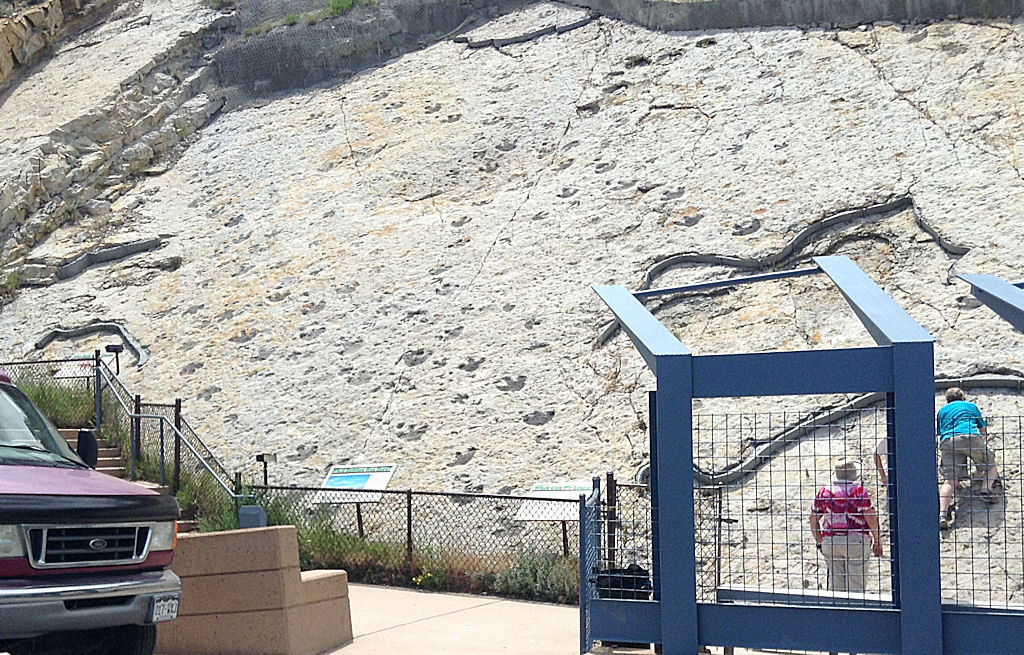
And the site was amazing. I believe this is the first time either of us has seen dinosaur tracks in place, where we were able to touch them. There are lots of tracks of various kinds, as it’s hypothesized that the area was a sea at one point (there are fossilized water-shaped ripples in some places) and that the dinosaurs walked through the mud and sediment that was left when the water receded. There were volcanoes in the area at one point as well that apparently affected the fossilizing process—the geology here is amazing, with many kinds of rocks. In addition to the tracks, many fossilized dinosaur bones have been found here as well, and some are still here. DuWayne showed us with a geiger counter that the bones embedded in the rock are slightly radioactive—the thinking is that the volcanoes emitted some radioactive material that then covered and seeped into the holes in the porous bones before they became fossilized, which left them radioactive.
 

Carol with her hand print in a dino's foot print.


Lots of dino tracks. Although the area is now inclined at about 45 degrees, it was once level marshland.

Mildly radioactive fossilized dino bones.

In addition to the fascinating fossils and geology, we also could see the Red Rocks Amphitheatre from the ridge, the open-air site of many great concerts (like our favorites, the Moody Blues) that we’ve seen on PBS television programs. Even the Beatles played here on their 1964 tour.
 

The famous Red Rocks Amphitheater

A final bonus was a sighting of a new bird for our list, the rufous-sided towhee (also called the spotted towhee), which DuWayne told us is relatively rare in this part of Colorado. It was a great tour and we really appreciate Kelly setting it up for us and DuWayne giving up his afternoon to inform and entertain us!
 

This was as close as Jack could get to the rufous-sided towhee.

When we got back, Jack and I decided to take off and get through Denver, since we want to keep fairly close to our driving schedule for our remaining week. We took some photos and said our farewells to Kelly, Todd and Laura. We hope Kelly and Todd will visit us soon in Virginia…. 
 

Kelly and Todd

Carol, Kelly and Jack


We made it through Denver at rush hour. (No thanks to me telling Jack the wrong instructions for one interstate ramp, which caused us to drive through city back streets for about 10 miles—at least we saw some of the older residential areas of Denver!) We finally got on I-70 east and as soon as we passed the Denver airport, the traffic slacked off and the terrain changed almost immediately to flat, flat plains/prairie. Lots of flat grazing land, and we saw several pronghorn antelope, which we hadn’t seen before on this trip. After driving awhile, we decided to stop at a motel and do some work, since we both need to catch up on our book projects.

Where we are:
 

We’re in Limon, CO now.

Bird species count: Vermilion flycatcher, turkey vulture, Bell’s vireo, *golden-fronted woodpecker, Say’s phoebe, northern cardinal, greater roadrunner, house finch, common raven, *northern rough-winged swallow, *summer tanager, *prothonotary warbler,  *yellow-breasted chat, *yellow-rumped warbler, northern mockingbird, mourning dove, cliff swallow, Mexican jay, black-headed grosbeak, black-chinned  hummingbird, Wilson’s warbler, *Scott’s oriole, chipping sparrow, house sparrow, lesser goldfinch, black-crested titmouse, acorn woodpecker, scrub jay, *western kingbird, white-winged dove, *canyon towhee, *Grace’s warbler, *zone-tailed hawk, *curve-billed thrasher, Bullock’s oriole, Gambel’s quail, great horned owl, black-throated sparrow, *cactus wren, ladder-backed woodpecker, white-crowned sparrow, brownheaded cowbird, Brewer’s blackbird, *pyrrhuloxia, hooded oriole, verdin, American st blog e and all the files uploaded. little wild iris. It'agebrush that we were riding over and through. Lupine looks crow, Anna’s hummingbird, dark-eyed junco, white-throated swift, Steller’s jay, mallard, common egret, brown pelican, western bluebird, loggerhead shrike, Audubon’s warbler, robin, Canada goose, black-billed magpie, red-winged blackbird, redtailed hawk, American dipper, *yellow warbler, tree swallow, osprey, mountain bluebird, peregrine falcon, green-tailed towhee, rufous-sided towhee

State count: 14 [Virginia, North Carolina, South Carolina, Georgia, Tennessee, Arkansas, Oklahoma, Texas, New Mexico, Arizona, California, Nevada, Utah, Colorado]  
     
Odometer count:
Surber, VA: 107,435
Limon, CO: 115,662  

Accommodations avg cost: 75 nts, avg $13.33/night