Thursday, October 13, 2016

Coasting in Oregon

After getting the van windshield replaced, our plan was to drive Highway 101 down the entire Oregon coast over a 3 or 4 day period, ending up in Eureka, CA on Friday afternoon to visit friends there. We spent Monday night in a motel in Vancouver, WA and caught up on our blog, since we had been way behind on it. Tuesday we headed west, following the course of the mighty Columbia River, all the way to the coast.

Since we are big fans of Meriwether Lewis and William Clark, our first stop on the coast was the Fort Clatsop Visitor Center, part of the Lewis and Clark National Historic Park. Here they have a reproduction of Fort Clatsop, the structure that the Corps of Discovery built near the mouth of the Columbia to winter over in, before they started their long journey home. It's in a magical forest with huge, moss-covered trees. We walked the short trail through the trees down to the site of their canoe landing and tried to imagine what it was like for the Corps being here, having made it all the way to the Pacific Ocean. They had a very hard winter here--nothing but cold rain and wind pretty much all the time.

Fort Clatsop reproduction in Lewis and Clark National Historic Park.

Jack with Sitka spruce tree in forest surrounding Fort Clatsop site.

As it turns out, the Clatsop Tribe of native Americans had already been here for hundreds of years and had been regularly trading furs with the British and others (they called them all "cloth men" because of the clothes they wore). The Clatsops were a bit puzzled by the Lewis and Clark expedition, since they didn't have much to trade with by that time, but the Indians helped Lewis and Clark tremendously by providing them with food and advice for surviving the winter. And as we found out, the Corps rewarded them by stealing one of their beautifully carved and extremely seaworthy canoes (that were sacred to the tribe) to use on the homeward journey. Oh well, at least when the soldiers left Lewis signed over Fort Clatsop and the furniture inside to their chief, and he lived there with his family for a few years.

Leaving the National Historic Park, we drove south toward the next town, Seaside, and found a campground nearby. We were craving some seafood and drove into town (very quaint and beachy) in search of clam chowder. We found it at Norma's, a local seafood favorite cafe, and it was definitely tasty!

We got up relatively early the next day so we could drive on down to the next town, Cannon Beach, and photograph it. The weather was going to turn nasty fairly soon and we wanted to take some photographs at this most-photographed spot on the Oregon coast, and also we wanted to beat the crowds, if any. We were almost the first ones at Ecola State Park, a high point overlooking Cannon Beach which is a well-known spot for taking photographs. It was a beautiful morning and the scenery is spectacular indeed from this spot. There were even some ripe marionberries up there, which Jack had to pick and try (sour).

View looking down on Cannon Beach from Ecola Point.

Small sailboat and rock with historic lighthouse on top, viewed from Ecola State Park.

Jack berry-picking.

As more people began to arrive in the parking lot, we started to get hungry and decided to look for some donuts down in Cannon Beach proper. We found a nice bakery and had coffee and donuts on their porch, while being besieged by crafty sparrows who snatched crumbs from under our feet. We then walked to a beach access road and walked on the beach awhile, taking more photos from this lower perspective. The icon of Cannon Beach is Haystack Rock, a huge basalt monolith right in the surf, that is the home of many seabirds and other sea creatures. It is very photogenic!

Haystack Rock, from close up.

Haystack Rock, from farther away. It's hard to stop taking pictures of it!

One more: Jack's artsy view with sand dune...

As we were making our way off the beach back to the van, we saw a marriage proposal written in the sand: "DOM WILL YOU MARRY ME?" in neat letters about 3 feet tall. Certainly a romantic spot!

The town is very cute too. It's a classy beach town, with historic buildings, cool architecture, and lots of art galleries. It is very popular and gets crowded during the summer season, but this is a good time to be here--nice and relaxed (but still quite a few people, especially around lunch time). Whale Park at one end of town has a statue commemorating the dead beached whale that Lewis and Clark came here to see (they took Sacagawea with them on that trek, apparently the only time she got to see the ocean).

Whale Park in Cannon Beach.


The Cannon Beach Post Office is beachy too.

(Oh, one other thing about Cannon Beach: the day before we got here, a surfer was attacked by a shark and had to be airlifted out due to extensive leg injuries. The guy was a trauma nurse and knew what to do--he punched the shark and it let him go, and then he had his buddies use the surfboard leash as a tourniquet while they waited for the ambulance. He's had surgery and is recovering.)

We got back on 101 and continued our drive south, feeling like we were working against time, since we knew a bad storm was heading our way and the next several days would be nothing but rain and wind. We stopped at most of the overlooks and took a bunch of photos.

Admiring yet another scenic coastal feature.

Typically scenic spot.

Another shot of that old lighthouse from Ecola Point.

What a view from this place!

The thing that surprised us both about the Oregon coast is the hundreds of miles of wide, white, soft sandy beaches! Most of the photos we'd seen of this area were green rocky cliffs with big waves beating on them, and lots of big rocks, like Haystack Rock, just offshore. These views do exist, but the beaches themselves are some of the prettiest beaches we've seen. And every 10 miles or so is a cute, quaint old seaside town or village, each with its own distinct character and feel. You could spend a lifetime driving this coast and not see it all!

At one viewpoint turnout, a steep rocky cliff dropped straight down to the surf about 1600 feet below. The explanatory plaque there said that men had quarried rock off the cliff face and used it to build a stone wall to hold up the cliff side, to support the road. Quite an engineering feat from the looks of it!

The engineer in us couldn't help admiring this huge rock wall construction.

The town of Tillamook is noted for its cheese manufacturing operation, and they offer tours and free samples, so we had to stop. They are a major cheddar brand and their cheese is great! We bought some.

A fun stop to watch people making cheese and sample several varieties.

Our last stop before camping for the night was Cape Kiwanda at the little town of Pacific City, which is noted for a fleet of fishing dories that launches and lands through the surf on the beach, to make their way out into the open ocean to fish for salmon, Dungeness crab, and various rock fish. They've been doing this for a long time. People drive their vehicles onto this beach, as is obvious from the photo, including trucks pulling dories on trailers. Signs warn to watch for high-speed dory boats landing through the surf. Unfortunately, we didn't see any.

Cape Kiwanda, launching spot for a fishing dory fleet. Can you believe these wide, sandy beaches? They're everywhere!

Cape Kiwanda has its own Haystack Rock, with a little arch in it, no less!

We camped at a nearby state park, and the rain began just about the time we got settled in. We were lulled to sleep by the sound of rain on the roof.

It was pouring down in the morning, so we resolved to get as far as we could down the coast without stopping too much, since we didn't think we'd be able to see very much through the rain and mist. We did get a few photos, however, one dramatic one of a lighthouse perched on the side of a big rock head in the surf. The surf looked quite different today than it did yesterday. As we got farther south we came to the National Dunes Recreation Area. Another surprise for us: we didn't associate Oregon with giant sand dunes, but it sure has them! Miles and miles of them! And yet another surprise was the cranberry bogs along the southern coast. (Oregon is known for its cheese, hazelnuts, and cranberries!)

Note the fragile-looking little lighthouse clinging to the side of the rock in the center of the photo. It has a bright light though, and does its job well!


Stormy view from one of the overlooks. Quite a bit different from yesterday!


Huge sand dunes along many miles of the southern coast. The rain had let up a little at this point.

The rain and wind got much worse in midafternoon, and we passed a serious wreck, which convinced us to stop for the night at the next campground, which was a KOA (with Wifi, yay). We're currently hunkered down--wind advisory here says gusts up to 80 mph, yikes. Tomorrow (Friday) will also be rainy but wind not as bad so we will skedaddle on down the coast and see if we can get to Eureka, CA. We were going to stop and visit the redwoods but we may have to wait on that a few days. Another nasty storm is heading this way on Saturday.

Tuesday, October 11, 2016

Fishing the Deschutes and Crooked Rivers

Deschutes River, Tuesday 4 October 2016

Bud and I decided to fish the Deschutes upstream of Maupin. There is a road on the east bank that was once a railroad providing passenger service to Maupin. Several miles upstream is a spot known as Locked Gate because, as you might have guessed, there is a locked gate across the road. A sign indicated you could walk upstream several miles, but no motorized vehicles were allowed. I was hoping to catch a red-band rainbow on a dry fly but I fished for several hours without a single strike. Carol and I watched Bud catch a nice red-band on a nymph in a riffle (Carol took some photos from a distance). This was in the same riffle where I had already fished, I might add. Bud said he had on a float indicator followed by two dropper nymphs. The three of us met downstream and had lunch.

Bud nets a nice one.

Bud nets another.

There was a very large eddy nearby. Carol reminded me she had read in one of my guide books that it was worth letting nymphs just circulate in the turbulent eddy waters. So I rigged up for nymphing and cast into the turbulent eddy. I would like to tell you that I immediately hooked into a monster, but that's not the way this river fishes. I must have cast my nymph into this eddy at least 50 times without so much as a nibble. In the meantime, Bud caught another good-size trout in the riffles that led to the eddy where I was fishing.


Maybe in desperation, I decided to let my strike indicator follow the entire length of the eddy, which was about 75 feet long. Not a good idea to have so much line out, but I was into trying anything at this point. Bud had walked up to the edge of the eddy to watch me fishing and he watched, as I did, my white floating indicator went zipping off toward the main current stream, immediately followed by a large fish jumping into the air. I have a strong suspicion that this fish was looking for the jerk who had just hooked him, because the fish headed straight toward me, forcing me to strip in line fast to keep tension on the fish. As my line seemed to go slack, I yelled at Bud that I think the fish got off and just left me with a snag. However, the snag started moving and I quickly found out the fish was still on and had planned his next trick, which was to power out toward the main current stripping line off my reel at a blazing rate. Fortunately the drag setting on my reel seemed to wear him down and I was able to reel the fish in, only to have it once again power out and strip line off my reel. This “power-out, then reel-in” game finally came to an end. I got the fish close enough to remove the hook and return the trout to the water.

Jack with fish on, finally.

It's a red-band rainbow.

Jack about to release the rainbow.

Crooked River Wednesday-Thursday, 5-6 October 2016

Bud and I drove the RoadTrek to the area north of Prineville, OR to fish the Crooked River, which emerges from a dirt irrigation dam. For about 12 miles below the dam the Bureau of Land Management (BLM) has several camping sites (which cost $8 to camp overnight, unless you have a Golden Age National Park card, then it's only $4).

We chose the campsite called Poison Butte where Carol and I had previously spent a night and where I had caught a trout during a late evening hatch. This time when we arrived in the afternoon, a hatch was already in progress. We suited up and both of us caught several trout in the 8- to 10-inch range. Bud caught at least one 14-inch trout. Dusk arrived with a cold rain so we decided to call it an evening.

Bud's red-band rainbow caught in Crooked River.

Up early the next morning, we suited up again and noticed a guide with two clients had arrived. While Bud and I grabbed the boulder area, the guide took his clients downstream to the spot where we had fished last night. We both caught fish, with just as many getting off the hook before landing them. Toward the end of our fishing day, I hooked into a sizable fish and, while trying to release him, I dropped a fly box into the water that I didn't want to lose. Just then the guide's clients, a husband and wife team, appeared and retrieved my fly box. I still had the fish on which I then reeled in and noticed it was a 12-14 inch whitefish. As the woman fisher reminded me, there are a lot of whitefish in this river, but it was the first we had caught. All the other fish we caught were rainbows.

Jack releasing a large whitefish.

As I stuck my fly box back into my waders and walked upstream to get Bud, I thought about how this beautiful stream earned its reputation as an introduction for novice anglers to all the types of waters available for stream fishing. It was certainly challenging to Bud and me.

Carol's Story
While Jack and Bud were off fishing the Crooked River for two days, I had a nice relaxing time in our little cabin. It was kind of rainy in Maupin so I mostly stayed in and read and paid bills and caught up on correspondence. And watched the seemingly tame mule deer wandering around the place. The guys got home late in the afternoon on Thursday and they regaled me with their fishing adventures.

Mule deer seem tame at the Oasis.

On Friday we had a lazy day – slept in and just hung around the cabin, eating, talking and working on our respective computers/tablets. We had planned to meet up with our friends Wayne and Ellen again so Bud could see them. They had a meeting Friday morning in Portland but would call us when they were done and we would then meet at a restaurant in The Dalles, about a 45-min drive from Maupin, on the Columbia River and about a half hour from where they live now. We ended up driving to The Dalles and meeting them at about 4 pm at a local brewery (Oregon has a lot of these). We had a great time chatting and reminiscing and telling stories. Since Jack and Bud had to meet their fishing guide early Saturday morning, we made it an early night.
Fishing the Deschutes with a Guide - 8 October 2016

It was still dark at 5:30 AM when Nate, our guide for the day, showed up with his large pickup hauling a trailer on which sat his boat. Just before I left our cabin, Carol asked me why I was not wearing my new waders, since my old waders had a hole somewhere near my butt, as I had discovered on Silver Creek. I gave her no reason because I was a bit ashamed that I had no reason, other than not wanting to look like a newbie flyfisher to the guide. I should have remembered that pride interferes with logic, but more on this later.

After introductions, we headed up the river to a spot not far from where Bud and I had previously fished. We busied ourselves setting up our rods while Nate singlehandedly launched his boat. Getting into the boat with waders and boots on is quite an ordeal. Swinging one leg over the gunwale, then the other, seemed like the way to go, but waders severely restrict your leg motion. Nate suggested the best way to enter the boat was to sit on the gunwale and then fall back onto the boat cushion, then swing both feet into the boat. This worked, but I suspect Bud and I were happy it was still dark.

Once we were seated, Nate paddled us into the middle of the river and headed downstream, where I could hear the roar of a rapid but could not see it. I think I made the comment that it's a brave person who heads into a rapid that you can't see. Nate replied, “Either that, or he's crazy.” Anyway, thank God, Nate knew the river well and navigated the rapid with only a few drops of water splashing on Bud and me.

Bud snaps a shot as we head into the first rapids.

Nate maneuvered the boat to the west side of the river, dropped his anchor, and proceeded to rig my 6-weight fly-rod for steelhead and trout. He set aside Bud's 5-weight rod and rigged another 6-weight rod for Bud. Each rig consisted of two heavily weighted nymph patterns topped off with a 3/4-inch spherical strike indicator. The distance from the strike indicator to the bottom nymph was about 7 feet. The size of the leader varied from 1x to 3x as I recall. Nate said oftentimes a steelhead will hit this rig and he didn't want the leader to break. The big size would not have any effect on the large desert red-band trout he hoped we would catch.

Armed with these rigs, he asked us to get out of the boat and watch while he demonstrated how to cast and fish the rig. The thing about the Deschutes River is that the fishing regulations state “no fishing from boats” so we have to get out and wade at every spot where the guide wants us to fish. Of course, getting out of the boat was just about as difficult as getting in. What works, Nate said, was to slide feet first toward the gunwale, then sit on the gunwale and slide into the water. This sorta worked.

By now it was getting to be daylight. Nate demonstrated his casting technique and explained how he wanted us to first cast near the bank, then in two-foot intervals work our way out as far as we could. After each cast we were to let the current take the strike indicator straight downstream without any drag and then allow the nymphs to float in the current for several seconds before starting to cast again. He did not want us to stay in one position fishing the same water over and over again.

While showing us the correct way to drift the rig, Nate caught a 14-16 inch red-band trout. I think he was a bit embarrassed and tried to quickly release the trout. I guess he figured we would think he was showing off. Of course, Bud and I were impressed that his methods obviously worked.

Nate separated Bud and me by about 20 yards and told us to yell if we had a fish on. He proceeded to rig another two spey rods for us to try. As I recall, Bud caught the first red-band trout, a hard-fighting beautiful trout with brilliant red sides. Then I caught a big fish which I was certain was an equally hard fighting red-band trout. After I got the fish in, it turned out to be a very large whitefish. Not long after that I caught another good sized whitefish. Bud started calling me “El Blanco.”

We continued to catch red-band trout, about one every 15 minutes. I never caught another whitefish and most of the red-band trout I caught were jumpers, lots of fun to catch.

Nate helping Jack release a red-band back into the river.

We spent an hour or so learning how to use a spey rod and cast for steelheads. Casting with a spey rod is very interesting. The line is weighted and the rod is long with two cork handles. You basically roll cast (no back swing like you do when dry fly fishing) and can cast 60 to 70 feet when everything goes right. You cast across and down the stream and then let the fly drift down and flutter in the current. It's a sport that some refer to as the “sport of 10,000 casts.” We ran into several anglers who had been on the river for a week, fished for steelhead every day and never caught any. One fellow said he was having two bad years in a row. I had already fished the Umqua for steelhead with a guide using a spey rod and caught nothing. But the chance that you can catch one of these very big, powerful fish keeps anglers trying and trying.

I want to get back to the story of my waders. Turned out that Nate wanted us to wade out into the current as far as we could because, as he said, the further out you can get, the more likely you are to catch trout or hook into a steelhead. Now the Deschutes is a big river and the current is strong. The further out you wade, the faster the current gets and the deeper the water gets. And that meant the closer the water got to that hole in the butt of my waders. Every step away from the bank I took, I could hear Carol saying, “Why aren't you taking your new waders?” Well, it got to be sort of a joke with Bud and Nate, with me on the butt end of the joke, so to speak. So I had to tell Carol this when we got back. You can guess what she said, and she was right.

Carol's Story
I had gone back to bed after the guys left at 5:30 am on Saturday. Then I did some grocery shopping, wrote and mailed some cards and got the van's propane tank filled. It was almost dark when the guys got home from their long day floating the river. They had more fishing stories to tell, and needed to refill their own tanks, so we went to the little Oasis cafe next to our cabin and had milkshakes. (They make many flavors of yummy, old-fashioned milkshakes.) Then we visited a while with the fishermen staying in the cabin next to ours. They obligingly took some photos of us clowning around with the goofy photo props out in the yard next to the cafe, making us look like muscle-men and bikini-clad bathing beauties. Jack and Bud were pretty wiped out after their long day in the cold river so it was another relatively early night!

The Oasis Cafe.

Bud and our neighbors telling fish stories.

Goofy photo of Jack, Carol and Bud.

Actual photo of Carol and Jack in our bathing suits.

I had scoped out a church in Maupin for Sunday, so I got up early and went there—the Maupin Community Church. It was a very friendly and welcoming nondenominational congregation, very similar to our church in Oriskany. I enjoyed the worship and fellowship.

Maupin Community Church.

When I got back to the cabin, the guys were up and ready to go out and fish some more, since it was their last day. We went back to one of the same spots they'd fished before, near Locked Gate. However, not too much luck this time. Jack had a couple of strikes but couldn't hook one, and Bud thought he had a strike but it was a weird one. I think they were tired from the day before. They tried one more spot but nothing. We talked to two different fellows who were fishing for steelhead and hadn't caught anything. (One said he hadn't caught anything for two years and the other was there at the campground for a week and hadn't had a bite. I don't know about this steelhead fishing....)

We consoled ourselves with another milkshake and went back to the cabin to get organized, since we were leaving Monday morning and taking Bud to the airport in Portland. It had been a very good week, with lots of trout caught and lots of beautiful country to see.

On Monday we got cleaned up and packed the van and headed off, with a plan to stop along the way to see Multnomah Falls, the tallest waterfall in Oregon, which is right off I-84 about a half hour from Portland. It was a perfectly clear and sunny morning, and when we got on the road we realized that we could see Mt. Hood in all its glory, for the first time! We stopped to take some photos. Also a little later in the drive we could see Mt. Adams clearly, which is in Washington state, and is over 12,000 ft.

Mt Hood on a perfectly clear morning.

Jack poses for a photo at Multnomah Falls.

We pulled off the interstate at the Multnomah Falls exit and were astonished at the size and power of this falls! One of the coolest waterfalls we've ever seen! It's in two levels and the combined drop is over 600 ft. You get wet from the spray a LONG way from it. An old stone bridge goes across just above the top of the second falls. There were several other nice waterfalls in the immediate area as well. We drove up to see Vista House, a stone structure built in 1918, from which you have a panoramic view of the Columbia Gorge. A beautiful area.

Carol taking in the vista at Vista House.

We got Bud to the airport in plenty of time and said our fond farewells, making plans for future trips. Then Jack and I headed off to get the windshield replaced in the van, as the crack has been growing ever since it got whacked by those rocks in Idaho. Nice to have a clean, clear windshield again!

Friday, October 7, 2016

Visit with Good Friends and Introduction to the Deschutes

Sorry for the long delay since the last blog. We've been in a lot of "no cell" areas and have had a delightfully busy time with friends. We're going to catch up in two stages: this blog will take us through Monday Oct. 3. We left the Umpqua and drove north to visit our friends Wayne and Ellen just over the Oregon state line in White Salmon, WA. They moved here from Maryland about a year ago. We planned to stay a few days with them and then drive over to Portland to meet Jack's fishing buddy Bud, who is flying in from CA to fish with Jack for a week.

Since we would pass the next river on Jack's list, the Deschutes, on the way up to White Salmon, we planned to stop and check it out. We had also read in our fishing guidebooks about the Crooked River, a wild and scenic river that is a tributary of the Deschutes and holds a lot of trout. Since we were also driving near it on Wednesday before we got to the Deschutes itself, we decided to stop and check it out. It's a tailwater of a dammed reservoir used for irrigation, but the 8-mile section downstream from the dam is on BLM land and it's a perfect-looking little trout stream. There were a lot of campgrounds on its banks, so we decided to stay and camp there one night and see if Jack could catch a fish. (By his rules, a fish caught in a major tributary of the Top 100 stream counts as a check-off.)

We pulled into a BLM campground called Poison Butte Campground ($4 a night with our Senior Natl Park card), and he fished for several hours with no luck. A woman moved into the river just downstream of him about dusk and he thought she must have seen something rising, but she didn't appear to catch anything. She left before it got dark and Jack moved into the hole where she had been fishing. Carol gave up watching and went back to the van to read. It got darker and darker and Carol wondered whether Jack would be able to find his way back to the van! She turned on the outside light as a beacon for him (we were the only ones in this campground that night). Finally he stumbled in, literally, way after dark to report that a big caddis hatch had come off just at dark and he had finally caught a trout, so he could check this river off (takes the pressure off, even though he and Bud will have lots more chances to catch a trout in the Deschutes next week).

Jack fishing the beautiful Crooked River.

We had breakfast and departed the next morning, our plan being to check out the Deschutes River and our cabin at The Oasis Resort in Maupin on our way to White Salmon. We rented a small rustic cabin with two beds right next to the river for next week when Bud is here, since our van would be very close quarters for three people to live and sleep in, so we stopped and looked at the place--looks cozy and cute, should do fine. The little town (pop: 463) is all about the river--rafting the rapids in summer and fishing for steelhead and trout all year. The river is wide and strong; we scouted it in a few places, and stopped at a fly shop near our cabin to talk to them about fishing and flies. And they finally had some fly threaders that Jack has been looking for, to help him when changing flies on the river since it's getting hard to see to thread the fine leaders through the tiny holes.

Our first look at the  mighty Deschutes, near our cabin in Maupin.

Fly shop next to our cabin in Maupin.

After amusing ourselves in and around Maupin for a couple of hours, we continued on our way to Wayne and Ellen's house, arriving about 5:30 pm. It was great to see them both again! Looks like the Pacific Northwest agrees with them very well. They are currently renting a charming, vintage house on a hill overlooking the Columbia River. They also can see Mt Hood from their front porch. And their landlady loves landscaping, so their yard is like something from a magazine! Wayne, who is an awesome cook (actually they both are), prepared an exotic vegetarian Ethiopian dish for supper, with some tastes of his amazing chocolate and huckleberry homemade ice creams for dessert.


Shots of Wayne and Ellen's adorable house in White Salmon, WA.

We had good wine and great talks, catching up on the last year's worth of activities and all the folks we know in common. They had some suggestions for things to see and do in the area while we're here. For the next day's activities, we decided to see the Yakama Nation's salmon fishery on the Klickitat River Trail, and also visit a winery, of which there are several here.

On Friday, we had to walk just a short way up the Klickitat Trail to see the Yakama people engaged in their traditional salmon fishing--fascinating! They construct somewhat rickety-looking wooden platforms that cling tenuously to the steep rocky cliffs, and they hang out on these over the monstrous rapids with long-handled nets to catch the large salmon jumping up the falls. Looks dangerous! We saw several large salmon being caught in this way. It was very cool to see!


Member of Yakama Nation catching nice salmon in his net as it tries to jump up the falls.

After watching this mesmerizing activity for awhile, we walked to a more secluded spot overlooking the river canyon and had a picnic of sandwiches, and then started off for the Syncline winery. There we did a wine tasting of several very good wines, and enjoyed talking to the handsome young man who was pouring. He was a graduate level philosophy major who had spent some time in the movie biz in LA and then decided he wanted to try his hand at the wine business instead. Interesting guy. He seems committed. He especially likes to write all the crazy stuff about their wines: "has aromas of wet stone complemented by notes of white pepper and star fruit." That kind of thing. We bought some of their very good wine. Couldn't really smell the wet stone aroma though. The guy as much as admitted he just makes that stuff up!

Wayne, Ellen and Carol at picnic site on edge of canyon overlooking the river.


Wine tasting.

After that, we decided to drive down onto a sandy beach area on the Columbia River Gorge and watch the kiteboarders (after stopping to pick up Maya, a Rottweiler belonging to a friend of theirs, who loves to go on outings with Wayne and Ellen). Kiteboarding is a major sport here--it's like surfing while being pulled by a giant kite. They move really fast and go way up in the air, even turning somersaults at times. Wayne and Ellen's son Weston and his wife Natalie are kiteboarders--one of the reasons they chose to live here after graduating from Va. Tech. Maya had a grand ol' time playing with the other dogs on the beach, until two tiny little Huskie pups started attacking her (playfully) and freaked her out!

Wayne and Maya with kiteboarders in background.

Kiteboarders on Columbia River Gorge near Hood River.

On our way back to their house, we stopped and bought some King salmon for supper and Wayne smoked it at home using his special method and it was absolutely the best salmon either of us have had! Also had a great green salad, with pears--this area is very big on pears, as well as lots of other kinds of fruit. And he also made a new batch of homemade huckleberry ice cream. We're in heaven. We made a plan for Saturday, which was to go on a hike to a waterfall, to be followed by a soak at a local hot springs, and then dinner somewhere in the area. Not a bad plan.

It was a little rainy and cool on Saturday so we suited up in rain gear for the approx. 4-mile hike to the waterfall. Nice hike, a little steep at times, but we took our time and stopped to look at the beautiful scenery. The waterfall was spectacular--200+ feet in three different levels! We had tuna sandwiches there, made with Wayne's homemade bread, and some good chocolate. Yum. We then drove to nearby Carson Hot Springs, a historic public hot springs where you pay for an hour-or-so soak in their mineral pool. Ahhhhh, perfect after a hike on a cool, rainy day! We then headed for a pizza place in Hood River, a quirky cute town, for supper. We ate outdoors on the patio, but they had heaters so it was pleasant. (They will even bring you a blankie if you want one.) People are nice and friendly and relaxed here. We had more huckleberry ice cream when we got home. To die for.

Some of the grand scenery as we hiked up to the waterfall.

We made it! Jack and Carol pose with waterfall.

Wayne and Ellen and waterfall.

We loved our few days with Wayne and Ellen and seeing their new world, but Sunday we had to say farewell, as our friend Bud was flying in and we had to pick him up at the Portland airport, about an hour's drive away. (Bud is also a friend of Wayne and Ellen, so we made plans to all get together at some point while he's here, since we won't be too far away.)

Bud arrived on time and we headed first to a fly shop in Portland, since Jack needed some new boots with studs on them, to safely wade the Deschutes River, which can be dangerous since it's such a big and powerful river. We found the Orvis shop, he got the boots (Carol's early Christmas and birthday present to him), and both he and Bud picked the brains of the guys working there, and bought some flies that are supposed to work well for the Deschutes trout. We then drove a "back way" to Maupin, going by Mount Hood and the Warm Springs Tribes reservation, and stopping for groceries and general supplies. We arrived at our fishing camp cabin about dark and got checked in, and had a fairly early night, with plans to scout the river and go fishing on Monday morning.

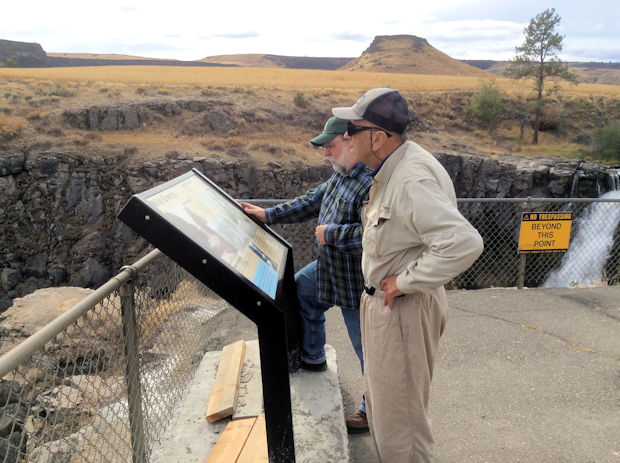
The morning was cloudy but pleasant. We had breakfast at the cabin and then drove around a bit to get the lay of the land (and the river, which is intimidatingly long and large). We found some river access roads and located a couple spots that the Orvis fly shop guys in Portland had recommended. During the scouting, we also went to look at White River Falls State Park, a small and seemingly very lightly visited park on a nice waterfall, which is also the site of a historic power plant. (White River is another tributary of the Deschutes.) The ruins are still there and Jack and Bud enjoyed looking at them. We had a picnic lunch (beanies and weenies) at the park.

White River Falls.

Bud and Jack check out the power plant ruins at the state park.

Jack and Bud finally settled down to fish at the Oak Springs BLM campground on the Deschutes Access Road, one of the "secret spots" that one Orvis guy had mentioned, and Carol took photos and watched birds. The guidebooks say to try to break this river down into different smaller rivers and focus just on the characteristics of the spot you're fishing and try to psych out what the fish are doing and eating there--i.e., stay put for a while and don't keep looking for greener pastures. They both tried a few different flies. Bud finally caught a nice trout, but Carol wasn't ready with the camera so we didn't get a picture of that one, unfortunately. Jack didn't catch anything this time. They were hoping for an evening hatch, but never saw anything rising so quit fishing when it got dark, resolving to try a different spot tomorrow.

Power plant ruins on White River.

Bud demonstrating good casting technique.

"The boys" fishing at dusk on the Deschutes.

We'll continue with more about the Deschutes fishing in the next blog, since we'll be here for awhile. I know we're behind on days, but we'll catch up soon!